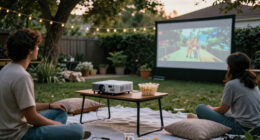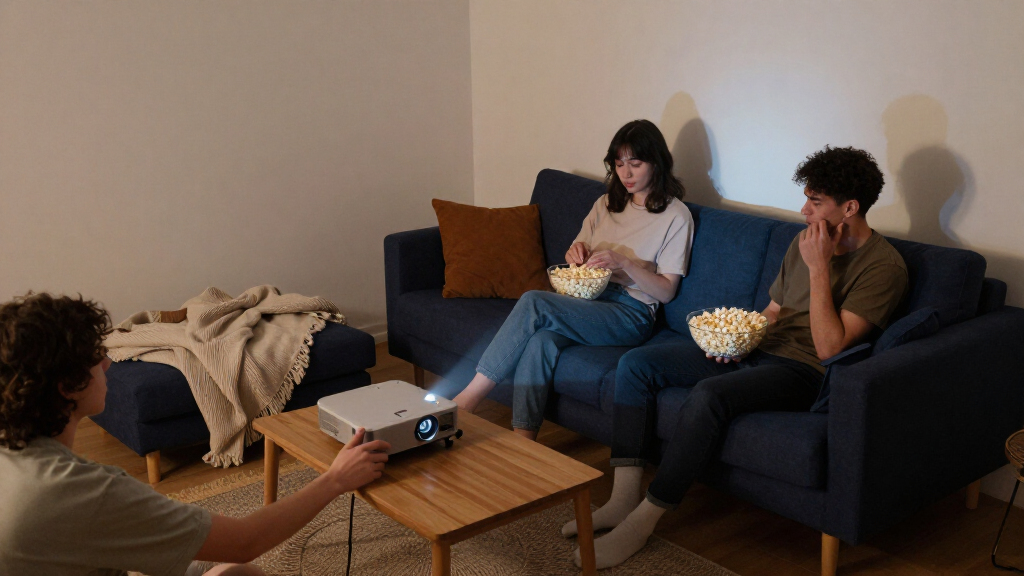

Movie night projectors have become the fastest way to turn a blank wall, a bedroom ceiling, or a backyard fence into a genuine theater, and the gap between a good one and a frustrating one comes down to three things: native resolution, real brightness, and how quickly you can go from box to picture. For most people, the WIMIUS K14 Smart Projector is the best overall pick, thanks to native 1080p, HDR10, built-in VIDAA OS streaming, and Wi-Fi 6 that spares you the dongle clutter. If you want something simpler and cheaper, the Aurzen Roku TV D1R Air puts a full Roku interface directly inside the projector, making it the easiest path to Netflix in the dark, while the GooDee YG600-Mini stands out for auto focus and keystone correction that remove the most annoying part of setup. The main tradeoff you’ll face in this category is image quality versus convenience — the brightest, sharpest models are bigger and need power outlets, while the tiny 180°-rotation minis are effortless to move but struggle outdoors. Keep reading for the full breakdown of all 15 models.

Get movie nights delivered free with Prime
- Fast, free delivery on millions of items
- Prime Video, Amazon Music and more included
- Member-only deals all year
Key Takeaways
- Built-in smart platforms (Roku on the Aurzen trio, VIDAA OS on the WIMIUS models) eliminated the need for external streaming sticks, which separated the top indoor picks from projector-only minis.
- Native 1080p mattered far more than ‘1080p support’ or ‘4K support’ marketing language — models like the HAPPRUN H1 and TMY delivered visibly sharper movie playback than upscaled rivals.
- Auto focus and auto keystone (only on the GooDee YG600-Mini) was the single biggest convenience differentiator, since every other model required manual fiddling before movie night.
- Bundled accessories split the value field: the PANSEBA and TMY include projection screens, making them better starter kits, while premium models assume you already own one.
- The 180° rotation design on the Magcubic and the Wi-Fi 6 portable mini opened up ceiling and angled-wall projection that traditional boxes can’t do, but both trade away brightness for flexibility.
| NICPOW Portable Mini Projector with 1080p Support | 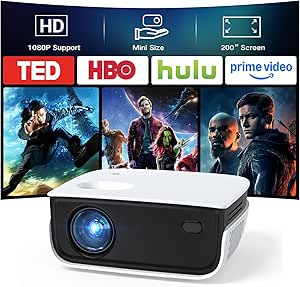 | Best for Simple, Portable Movie Nights | Supported resolution: 1080p | Maximum screen size: 200 inches | Dimensions: 6.41 × 5.11 × 2.67 inches | VIEW LATEST PRICE | See Our Full Breakdown |
| Magcubic Mini Projector with Wi-Fi 6, Bluetooth 5.4, and 180° Rotation |  | Best for Flexible Placement | Native resolution: 1280 × 720 | Maximum supported resolution: 4096 × 2160 pixels | Brightness: 200 ANSI lumens | VIEW LATEST PRICE | See Our Full Breakdown |
| PANSEBA 1080p Mini Projector with Screen and Two-Way Bluetooth |  | Best for Bluetooth Audio Pairing | Resolution: Supports 1080p | Contrast ratio: 8000:1 | Bluetooth: Two-way Bluetooth 5.2 | VIEW LATEST PRICE | See Our Full Breakdown |
| Portable Mini Projector with Wi-Fi 6, Bluetooth 5.4, 4K Support, and 180° Rotation |  | Best for Auto Setup in a Compact Room | Native resolution: 1280 × 720 | Maximum display resolution: 4096 × 2160 pixels | Brightness: 8000 (unit not specified) | VIEW LATEST PRICE | See Our Full Breakdown |
| WIMIUS K14 Smart Projector with VIDAA OS, Native 1080p, 4K Decoding, HDR10, Wi-Fi 6, and Dolby Audio |  | Best Premium Home Movie Projector | Operating system: VIDAA Smart OS | Resolution: Native 1080p; 4K decoding | Brightness: 1450 ISO ANSI lumens | VIEW LATEST PRICE | See Our Full Breakdown |
| HOMPOW Mini Portable Projector with Bluetooth |  | Best Budget Starter Pick | Native resolution: 1280 × 720 | Maximum supported resolution: 1080p Full HD | Brightness: 200 lm | VIEW LATEST PRICE | See Our Full Breakdown |
| GooDee YG600-Mini Smart Projector with Wi-Fi 6, Bluetooth 5.4, Auto Focus, and Keystone Correction |  | Best All-in-One Smart Projector | Native resolution: 1080p | Maximum supported input: 4K (up to 3840 × 2160) | HDR: Supported | VIEW LATEST PRICE | See Our Full Breakdown |
| Aurzen Roku TV D1R Air Portable Smart Projector |  | Best for Roku Households | Resolution: Native 1080p | Brightness: 300 ANSI lumens | Power input: 65W+ USB-C PD (20V/3.25A) | VIEW LATEST PRICE | See Our Full Breakdown |
| Q100 Portable Mini Projector with 1080p Support |  | Best for Giant Screen Enthusiasts | Native resolution: 1080p support (1920 × 1080 max) | Brightness: 1500 lumens | Contrast ratio: 20,000:1 | VIEW LATEST PRICE | See Our Full Breakdown |
| HAPPRUN H1 Native 1080p Portable Bluetooth Projector |  | Best Native Full HD Value | Native resolution: 1920 × 1080 | Brightness: 300 ANSI lumens | Contrast ratio: 10,000:1 | VIEW LATEST PRICE | See Our Full Breakdown |
| NISOO Mini Projector with Wi-Fi and Bluetooth |  | Best for Flexible Connections | Resolution: 1080P | Projection size: 32–200 inches | Projection distance: 1.5–5 m | VIEW LATEST PRICE | See Our Full Breakdown |
| TMY Native 1080p Mini Portable Projector with Two-Way Bluetooth and 80-Inch Screen |  | Best Starter Bundle | Native resolution: 1280 × 720 | Maximum display resolution: 1920 × 1080 | Display type: LCD | VIEW LATEST PRICE | See Our Full Breakdown |
| WiMiUS P62 Pro Smart Projector with Wi-Fi 6 and Bluetooth |  | Best Built-In Streaming Upgrade | Native resolution: 1080p | 4K support: Yes; displays at native 1080p | Brightness: 600 ANSI lumens | VIEW LATEST PRICE | See Our Full Breakdown |
| Aurzen Roku D1R Smart Projector |  | Best for Roku Users | Resolution: 1080p Full HD | Projected image size: 60–150 inches | Wi-Fi: Dual-band 2.4 GHz and 5 GHz | VIEW LATEST PRICE | See Our Full Breakdown |
| Aurzen Roku TV E1R Smart Portable Mini Projector |  | Best Compact Pick | Connectivity: Wi-Fi 2.4 GHz/5 GHz, two-way Bluetooth 5.2 | Projection size: 20–120 inches | Throw ratio: 1.12:1 | VIEW LATEST PRICE | See Our Full Breakdown |
| movie night projector | Connectivity | Native resolution | Brightness |
|---|---|---|---|
| NICPOW Portable Mini Projector | HDMI, USB, AV | — | — |
| Magcubic Mini Projector with W | Wi-Fi 6, Bluetooth 5.4, HDMI, USB | 1280 × 720 | 200 ANSI lumens |
| PANSEBA 1080p Mini Projector w | — | — | — |
| Portable Mini Projector with W | Wi-Fi 6, Bluetooth 5.4, HDMI, USB | 1280 × 720 | 8000 (unit not specified) |
| WIMIUS K14 Smart Projector wit | — | — | 1450 ISO ANSI lumens |
| HOMPOW Mini Portable Projector | — | 1280 × 720 | 200 lm |
| GooDee YG600-Mini Smart Projec | — | 1080p | — |
| Aurzen Roku TV D1R Air Portabl | — | — | 300 ANSI lumens |
| Q100 Portable Mini Projector w | HDMI, USB, 3.5mm AUX only | 1080p support (1920 × 1080 max) | 1500 lumens |
| HAPPRUN H1 Native 1080p Portab | HDMI, USB, 3.5mm jack, IR | 1920 × 1080 | 300 ANSI lumens |
| NISOO Mini Projector with Wi-F | Wi-Fi, Bluetooth | — | — |
| TMY Native 1080p Mini Portable | 3.5 mm jack, Bluetooth, HDMI, USB | 1280 × 720 | — |
| WiMiUS P62 Pro Smart Projector | — | 1080p | 600 ANSI lumens |
| Aurzen Roku D1R Smart Projecto | — | — | — |
| Aurzen Roku TV E1R Smart Porta | Wi-Fi 2.4 GHz/5 GHz, two-way Bluetooth 5.2 | — | — |
More Details on Our Top Picks
NICPOW Portable Mini Projector with 1080p Support
The NICPOW is a straightforward pick for movie nights where easy portability matters more than built-in streaming. At 1.1 pounds, it is easy to move between a bedroom, backyard, or travel bag, and its HDMI, USB, and AV inputs give you several ways to connect a playback device. It supports 1080p input and images up to 200 inches, though that large image is best saved for a dark room. Compared with the Magcubic Mini Projector, NICPOW lacks Wi-Fi, Bluetooth, and built-in apps, so you will need a connected device and cables. That simpler setup may suit buyers who already own a streaming stick or laptop. Skip it if you want wireless playback or a projector that handles brighter rooms.
Pros:- Light 1.1-pound body is easy to carry between rooms or outdoors
- HDMI, USB, and AV inputs support a range of connected devices
- Supports screen sizes up to 200 inches
- 1080p input support suits casual film and gaming use
Cons:- Needs a dark environment for its best-looking picture
- No Wi-Fi or Bluetooth for wireless streaming or audio
- Streaming devices and their cables are not included
Best for: Movie watchers who already have an HDMI playback device and want a light projector for dark rooms or occasional backyard use
Not ideal for: Buyers who want built-in streaming, wireless audio, or convenient viewing in a room with ambient light
- Supported resolution:1080p
- Maximum screen size:200 inches
- Dimensions:6.41 × 5.11 × 2.67 inches
- Weight:1.1 lbs
- Connectivity:HDMI, USB, AV
- Best viewing environment:Dark rooms
Our verdict“Choose the NICPOW if you want a compact wired projector for dark-room movie nights and already have a playback device.”
Magcubic Mini Projector with Wi-Fi 6, Bluetooth 5.4, and 180° Rotation
The Magcubic makes sense for casual movie nights where wireless convenience and unusual placement matter more than fine detail. Its 180° rotation helps aim the picture at a wall or ceiling, while built-in apps, Wi-Fi 6, Bluetooth, and a voice-control remote reduce the gear needed around the room. The tradeoff is its native 720p resolution: accepting 4K input does not make the projected image 4K. Its 200 ANSI lumens also favor dark viewing, and the stated image-size range starts at 80 inches, which may be too large for a small wall. Compared with the wired NICPOW, Magcubic is more self-contained but supports a smaller maximum image and puts less emphasis on 1080p input.
Pros:- 180° rotation supports flexible aiming, including toward a ceiling
- Built-in apps, Wi-Fi 6, and voice-control remote reduce extra equipment
- Bluetooth 5.4 supports wireless audio connections
- At 0.88 lb, it is easy to move and store
Cons:- Native resolution is 1280 × 720 despite accepting higher-resolution input
- 200 ANSI lumens limits its usefulness in rooms with ambient light
- Minimum stated image size of 80 inches may not suit small spaces
Best for: Renters and casual viewers who want a lightweight projector that can aim at a wall or ceiling and play from built-in apps
Not ideal for: Viewers who prioritize sharp native 1080p detail, bright-room use, or a small projected image
- Native resolution:1280 × 720
- Maximum supported resolution:4096 × 2160 pixels
- Brightness:200 ANSI lumens
- Contrast ratio:2000:1
- Image size:80–130 inches
- Throw distance:0.6–2.6 meters
- Connectivity:Wi-Fi 6, Bluetooth 5.4, HDMI, USB
- Weight:0.88 lb
Our verdict“Pick the Magcubic for flexible, app-based movie nights in a dark room when convenience matters more than native 1080p resolution.”
PANSEBA 1080p Mini Projector with Screen and Two-Way Bluetooth
The PANSEBA stands out for movie nights built around Bluetooth audio flexibility. Its two-way Bluetooth can send sound to a separate speaker and support audio playback connections, giving buyers more options than the wired-only NICPOW. It also supports 1080p and images up to 200 inches, so it can serve a larger wall when the room is dark. The listed inputs are HDMI and USB, but phone adapters and HDMI cables are not included; buyers should plan around the devices they already own. A further streaming caveat is that mirrored connections are incompatible with Hulu, which makes a direct app-capable playback device a better route for that service. Compared with the app-equipped Magcubic, PANSEBA offers audio pairing but less built-in convenience.
Pros:- Two-way Bluetooth adds flexibility for connecting audio devices
- Supports 1080p input for movie playback
- Supports images up to 200 inches
- HDMI and USB provide wired playback options
Cons:- Phone adapters and HDMI cables are not included
- Mirrored connections are incompatible with Hulu
- No brightness figure is provided, making room-light suitability hard to judge
Best for: Viewers who want to pair a projector with a Bluetooth speaker for indoor or outdoor film nights
Not ideal for: Buyers who rely on phone mirroring for Hulu or expect adapters and HDMI cables to be included
- Resolution:Supports 1080p
- Contrast ratio:8000:1
- Bluetooth:Two-way Bluetooth 5.2
- Maximum screen size:200 inches
- Lamp life:Up to 50,000 hours
- Inputs:HDMI, USB
- Included screen:Screen included
Our verdict“Choose the PANSEBA if Bluetooth speaker pairing is central to your movie setup and you can connect streaming sources directly.”
Portable Mini Projector with Wi-Fi 6, Bluetooth 5.4, 4K Support, and 180° Rotation
This mini projector is aimed at viewers who want quick placement and built-in streaming in a small, movable package. Auto focus, screen alignment, and digital keystone correction can reduce the manual adjustments involved when moving it between rooms; its 180° rotation adds more placement options. Built-in apps, Wi-Fi 6, and a 5W speaker also make a casual movie setup easier to assemble than the NICPOW, which relies on wired sources. Resolution is the main compromise: the native panel is 720p, even though it accepts higher-resolution content. The listed brightness figure has no unit, so it cannot establish how well the projector will handle ambient light. Streaming services must run through the projector’s apps because copyright protection blocks direct phone mirroring.
Pros:- Auto focus, screen alignment, and keystone correction simplify setup
- 180° rotation allows flexible placement
- Built-in streaming apps, Wi-Fi 6, and Bluetooth 5.4 add connection options
- Light 0.88-pound design is easy to relocate
Cons:- Native resolution is 1280 × 720, with higher resolutions handled as input
- Brightness is listed as 8000 without a unit, so room-light performance is unclear
- Streaming services must be played through built-in apps rather than mirrored from a phone
Best for: People in compact homes who move a projector between rooms and want automatic image adjustment with built-in apps
Not ideal for: Viewers seeking native 1080p sharpness, dependable bright-room performance, or phone mirroring for streaming services
- Native resolution:1280 × 720
- Maximum display resolution:4096 × 2160 pixels
- Brightness:8000 (unit not specified)
- Speaker:5W
- Connectivity:Wi-Fi 6, Bluetooth 5.4, HDMI, USB
- Rotation:180°
- Weight:0.88 lbs
- Recommended viewing distance:5.2 ft for an 80-inch screen
Our verdict“Pick this model for movable, app-based movie nights where automatic setup matters more than native 1080p detail.”
WIMIUS K14 Smart Projector with VIDAA OS, Native 1080p, 4K Decoding, HDR10, Wi-Fi 6, and Dolby Audio
The WIMIUS K14 is the strongest fit here for a more complete home movie-night setup. Unlike the 720p Magcubic and rotating mini model, it has a native 1080p image, plus VIDAA apps, HDR10, and a stated 1450 ISO ANSI lumens for a larger, more capable indoor viewing setup. Dual 30W Dolby Audio speakers can reduce the need for a separate sound system, while automatic focus and image correction help with placement. Wi-Fi 6, AirPlay, and HDMI 2.1 offer broader source options than the simpler PANSEBA. It is still not native 4K: 4K content is decoded for display at the projector’s native resolution. Its digital zoom range is limited to 50%–100%, and its feature set is more than a casual portable viewer may need.
Pros:- Native 1080p resolution provides more detail than the lineup’s 720p mini models
- VIDAA OS provides streaming services and live TV channels
- Dual 30W Dolby Audio speakers support fuller sound without separate speakers
- Auto focus, keystone correction, screen fit, and obstacle avoidance simplify setup
Cons:- 4K content is decoded rather than displayed at native 4K resolution
- Digital zoom is limited to a 50%–100% range
- Feature-rich home setup is less suited to buyers focused on minimal travel gear
Best for: Households seeking a feature-rich 1080p projector with built-in streaming and powerful onboard audio for regular movie nights
Not ideal for: Travelers prioritizing minimal weight or buyers who require native 4K projection
- Operating system:VIDAA Smart OS
- Resolution:Native 1080p; 4K decoding
- Brightness:1450 ISO ANSI lumens
- HDR:HDR10
- Audio:Dolby Audio; dual 30W speakers
- Wireless connectivity:Wi-Fi 6; Bluetooth 5.4
- Ports:HDMI 2.1; HDMI ARC and CEC
- Noise level:30 dB in Standard Mode
- Image setup:Auto focus, 6D keystone correction, screen fit, obstacle avoidance, 50%–100% digital zoom
Our verdict“Choose the WIMIUS K14 for a home-centered movie setup that prioritizes native 1080p, streaming access, and substantial built-in audio.”
HOMPOW Mini Portable Projector with Bluetooth
For a first dip into backyard movie nights, the HOMPOW Mini keeps things simple and affordable. Its real appeal is portability — at 0.7 kg, it is lighter than nearly everything else in this lineup, including the compact Aurzen Roku D1R Air, and it travels easily to a friend’s house or a tent. The tradeoff is resolution: it displays at native 720p, accepting 1080p only as input, which puts it a step behind the native-1080p GooDee YG600-Mini and HAPPRUN H1 in sharpness. Two-way Bluetooth 5.1 and built-in 5W speakers mean there is no soundbar required, though the audio is thinner than GooDee’s 30W Dolby setup. Compared with the Q100, which lacks wireless entirely, the HOMPOW at least streams audio without cables. The auto-off timer is a nice touch for kids’ sleepovers.
Pros:- Extremely lightweight at 0.7 kg for genuine portability
- Two-way Bluetooth and built-in 5W speakers eliminate extra audio gear
- Auto-off timer and quiet operation suit family and kids’ use
- Zoom from 50% to 100% without moving the projector
Cons:- Native display resolution is only 720p despite 1080p input support
- Screen mirroring adapters for phones are sold separately
Best for: Casual first-time buyers and families with kids who want an inexpensive, take-anywhere projector for occasional movie nights
Not ideal for: Detail-focused viewers who expect true Full HD sharpness — the native 720p panel will look soft on screens above 80 inches
- Native resolution:1280 × 720
- Maximum supported resolution:1080p Full HD
- Brightness:200 lm
- Bluetooth:5.1, two-way
- Image size:40–120 in
- Weight:0.7 kg
- Light source life:50,000 hours
Our verdict“A sensible entry point for low-stakes movie nights where portability matters more than pixel-perfect detail.”
GooDee YG600-Mini Smart Projector with Wi-Fi 6, Bluetooth 5.4, Auto Focus, and Keystone Correction
The GooDee YG600-Mini is the closest thing here to a projector that replaces a TV. With built-in streaming apps, an app store, and a browser, it needs no dongle or TV stick — a step ahead of the HAPPRUN H1, which requires you to supply your own streaming stick. Its auto focus and auto keystone correction, plus obstacle avoidance, mean the picture aligns itself, whereas the Q100 demands more manual fiddling. Audio is the standout among this batch: dual 15W Dolby speakers outclass the small built-ins of the HOMPOW and Aurzen Roku D1R Air. The honest caveats are that 4K is input-only — the panel itself is native 1080p — and HDR playback depends on your streaming service and subscription tier. Still, paired with Wi-Fi 6, this is the most complete package in the group.
Pros:- Built-in streaming apps, app store, and browser with no dongle needed
- Auto focus, keystone correction, and screen adaptation simplify setup
- Powerful 30W dual speakers with Dolby Audio
- Wi-Fi 6 and Bluetooth 5.4 for fast wireless connections
Cons:- 4K is supported only as input and decoding, not native display
- HDR availability depends on subscription, service, device, and content
Best for: Buyers who want a no-extra-hardware home cinema with streaming apps and strong built-in sound already included
Not ideal for: Viewers chasing true 4K output — 4K here is decoding only, and HDR access varies by subscription and content
- Native resolution:1080p
- Maximum supported input:4K (up to 3840 × 2160)
- HDR:Supported
- Contrast ratio:20,000:1
- Speakers:2 × 15W (30W total), Dolby Audio
- Wireless:Dual-band Wi-Fi 6, Bluetooth 5.4
- Image adjustment:Auto focus, auto keystone, obstacle avoidance, screen adaptation
Our verdict“The pick for anyone who wants streaming, sound, and setup automation in one box instead of assembling a system piece by piece.”
Aurzen Roku TV D1R Air Portable Smart Projector
If your household already lives inside the Roku ecosystem, this projector removes every layer of setup friction — the streaming interface is built in, so there is no stick to buy and no separate remote to juggle. That gives it an edge over the HAPPRUN H1, which leans on an external TV stick you must purchase separately. The gimbal stand and USB-C PD power input make it genuinely mobile; unlike the desk-bound Q100, you can angle it freely or run it from a compatible power bank. Picture quality holds up with native 1080p, TOF autofocus, and auto keystone correction. The constraints are real, though: 300 ANSI lumens means it is firmly a dark-room or after-sunset projector, it demands a 65W+ USB-C PD source and 5A E-Marker cable, and fan noise of 29–35 dB may be audible during quiet dialogue scenes.
Pros:- Roku TV built in for direct access to streaming apps and channels
- Native 1080p with TOF autofocus and automatic keystone correction
- Gimbal stand and USB-C PD power support flexible placement
- Broad connectivity including HDMI, USB, Bluetooth 5.2, and audio out
Cons:- 300 ANSI lumens requires dark or low-light viewing conditions
- Needs a compatible 65W+ USB-C PD source and 5A E-Marker cable
- Fan noise of 29–35 dB may be noticeable in quiet scenes
Best for: Roku users and frequent movers who want built-in streaming and a pivoting design for indoor and outdoor low-light viewing
Not ideal for: Daytime or lamp-lit rooms — 300 ANSI lumens washes out unless the space is nearly dark, and the power requirements add cost
- Resolution:Native 1080p
- Brightness:300 ANSI lumens
- Power input:65W+ USB-C PD (20V/3.25A)
- Weight:1.18 kg (2.60 lb)
- Speakers:Dual 5W with Dolby Audio
- Setup:TOF autofocus and automatic keystone correction
- Recommended setup:80 in image at ~7.26 ft
Our verdict“The easiest path to movie night for Roku devotees, provided the lights stay off and you have the right USB-C power source.”
Q100 Portable Mini Projector with 1080p Support
The Q100 is built around one ambition: maximum image size. It projects up to 200 inches, matching the HAPPRUN H1 but far outstripping the HOMPOW Mini’s 120-inch ceiling, and its 270° rotatable stand means you can point it at a ceiling for bedtime viewing without a mount. Its high lumen rating makes it more forgiving of ambient light than the 300-ANSI-lumen Aurzen D1R Air, though raw lumen figures are not directly comparable across brands. The catch is that this is a wired-only projector — no Wi-Fi, no Bluetooth, no built-in apps — so everything runs over HDMI, USB, or AUX, and phone mirroring requires a physical USB cable. Compared with the fully wireless GooDee YG600-Mini, the Q100 trades convenience for screen real estate. For DIY home theater builders who already own a laptop or console, that trade can make sense.
Pros:- Supports images up to 200 inches for true big-screen viewing
- 270° rotatable stand and ±60° angle adjustment enable ceiling and wall projection
- HDMI, USB, and AUX cover a wide range of source devices
- LED lamp rated for up to 50,000 hours
Cons:- No Wi-Fi, Bluetooth, or built-in streaming apps
- Phone mirroring requires a wired USB connection
Best for: Source-device owners — laptop, console, or Blu-ray player users — who want a massive image or ceiling projection on a budget
Not ideal for: Cable-averse streamers — with no Wi-Fi, Bluetooth, or apps, every movie night starts with plugging something in
- Native resolution:1080p support (1920 × 1080 max)
- Brightness:1500 lumens
- Contrast ratio:20,000:1
- Image size:30–200 inches
- Throw distance:2.5–16.5 feet
- Stand rotation:270° with ±60° angle adjustment
- Connectivity:HDMI, USB, 3.5mm AUX only
Our verdict“Choose this if sheer screen size and flexible placement outweigh the convenience of wireless streaming.”
HAPPRUN H1 Native 1080p Portable Bluetooth Projector
The HAPPRUN H1 delivers a true native 1920 × 1080 panel, which gives it crisper detail than the HOMPOW Mini’s 720p display and equal footing with the GooDee YG600-Mini on resolution. It also shares the Q100’s ability to project up to 200 inches, and offers flexible mounting on a desktop, tripod, or ceiling. Bluetooth 5.3 lets you push audio to external speakers for better sound than any built-in unit can manage — but note it is audio-only, so video casting from a phone is off the table, and you will need a TV stick (sold separately) to stream. At 300 ANSI lumens, plan on a dim room, much like the Aurzen D1R Air. Compared with the fully self-contained GooDee, the H1 is more of a build-it-yourself projector: sharp picture, but you supply the streaming and possibly the sound.
Pros:- True native 1920 × 1080 resolution for sharp Full HD detail
- Supports image sizes up to 200 inches
- Bluetooth 5.3 audio pairing with external speakers
- Desktop, tripod, and ceiling mounting options
Cons:- TV stick and phone-to-HDMI adapters are sold separately
- Bluetooth is audio-only, with no video casting
- 300 ANSI lumens limits viewing to darker environments
Best for: Value-minded buyers who already own a TV stick and Bluetooth speakers and want genuine native 1080p sharpness at a large screen size
Not ideal for: Anyone wanting a plug-and-play streaming projector — the stick, phone adapters, and possibly speakers are extra purchases
- Native resolution:1920 × 1080
- Brightness:300 ANSI lumens
- Contrast ratio:10,000:1
- Image size:40–200 inches
- Bluetooth:5.3 (audio only)
- Connectivity:HDMI, USB, 3.5mm jack, IR
- Light source life:100,000 hours
Our verdict“A sharp native-1080p canvas for buyers who already have the streaming and audio pieces and want to skip paying for built-ins.”
NISOO Mini Projector with Wi-Fi and Bluetooth
The NISOO suits movie nights where the source might change from a laptop to a USB drive or Micro SD card. Its Wi-Fi and Bluetooth add wireless options, while HDMI and adjustable focus and keystone correction help fit the picture to a living room or backyard setup. Compared with the TMY Native 1080p Mini Portable Projector, which includes an 80-inch screen, NISOO leaves the screen choice to you but offers a wider set of listed media connections. Its 32–200-inch projection range gives room to scale the image, though movie viewing is recommended in low-light settings. Built-in stereo speakers simplify setup, but Bluetooth support offers a route to external audio if those speakers are not enough. Phone-connected streaming may be limited because some services do not play through phone connections, and this is not suited to text-heavy presentations.
Pros:- Wi-Fi and Bluetooth provide wireless connection options
- HDMI, USB, and Micro SD support several kinds of media sources
- Focus and keystone correction help adjust the image for different placements
- Bluetooth can send audio to an external speaker
Cons:- Best suited to low-light viewing
- Some streaming videos may not play through phone connections
- Not intended for professional presentations or text projection
Best for: Movie watchers who switch among HDMI devices, USB media, and Micro SD cards and can control room lighting
Not ideal for: Buyers who want a projector designed for sharp text presentations or dependable streaming through phone mirroring
- Resolution:1080P
- Projection size:32–200 inches
- Projection distance:1.5–5 m
- Connectivity:Wi-Fi, Bluetooth
- Ports:HDMI, USB, Micro SD
- Audio:Built-in stereo speakers; supports Bluetooth external speakers
- Recommended environment:Low-light settings
Our verdict“Choose the NISOO if you want flexible wired and wireless source options for low-light movie nights and do not rely on phone mirroring for every streaming app.”
TMY Native 1080p Mini Portable Projector with Two-Way Bluetooth and 80-Inch Screen
The TMY is the most ready-to-set-up choice here because an 80-inch foldable screen comes with the projector. That can spare first-time buyers the extra step of sourcing a suitable surface, while its built-in speaker and Bluetooth audio leave room for a simple or upgraded sound setup. The key tradeoff is resolution: despite the product name and support for higher-resolution input, its native resolution is 1280 × 720. Compared with the NISOO, which lists 1080P resolution and Micro SD connectivity, TMY offers a bundled screen and a broader maximum projection size, but it is less compelling for buyers prioritizing native image detail. Phone adapters may be needed and are not included, and some streaming apps may not mirror properly. Its portability and included screen favor casual movie nights over a plug-and-play phone streaming setup.
Pros:- Includes an 80-inch foldable screen
- Portable design supports a wide projection-size range
- Bluetooth audio and a built-in speaker offer flexible sound options
- HDMI and USB support compatible devices
Cons:- Native resolution is 720p, even though higher-resolution input is supported
- Phone adapters and some connection cables are not included
- Screen mirroring may fail with some streaming apps
Best for: First-time projector buyers who want a portable setup with a screen included and plan to connect compatible HDMI or USB sources
Not ideal for: Viewers who want native 1080p detail or expect every streaming app to work through phone mirroring
- Native resolution:1280 × 720
- Maximum display resolution:1920 × 1080
- Display type:LCD
- Included screen:80-inch foldable screen
- Projection size:32–220 inches
- Projection distance:1.5–6 m
- Connectivity:3.5 mm jack, Bluetooth, HDMI, USB
- Lamp lifetime:10,000 hours
Our verdict“Pick TMY for a portable movie-night bundle with a screen included, provided its native 720p resolution fits your expectations.”
WiMiUS P62 Pro Smart Projector with Wi-Fi 6 and Bluetooth
The WiMiUS P62 Pro is the strongest fit for movie nights centered on apps and quick setup. Its built-in streaming apps reduce dependence on a separate streaming stick, while auto focus, auto keystone correction, obstacle avoidance, and screen alignment help get a picture into place with less manual adjustment. It also leads the Roku D1R on listed speaker power, with dual 10W speakers and Dolby audio; the D1R instead offers Roku streaming and 1080p output without a brightness figure in the supplied details. P62 Pro lists 600 ANSI lumens, so a darkened room remains the sensible setting. Its 4K support means it accepts that content, but it displays at native 1080p. Buyers who move it between locations should also account for the missing carrying case.
Pros:- Built-in apps include Prime Video and YouTube
- Auto focus and image correction features simplify setup
- Dual 10W speakers with Dolby audio are built in
- Wi-Fi 6, Bluetooth 5.2, dual HDMI, and dual USB give several connection paths
Cons:- 4K content displays at the native 1080p resolution
- 600 ANSI lumens makes darkened-room viewing the better fit
- Carrying case is not included
Best for: Movie watchers who want built-in streaming apps, automated image setup, and stronger listed speaker output in a darkened room
Not ideal for: Buyers seeking native 4K projection or a complete portable kit with a carrying case
- Native resolution:1080p
- 4K support:Yes; displays at native 1080p
- Brightness:600 ANSI lumens
- HDR:HDR10
- Built-in apps:Prime Video, YouTube, and other apps
- Speakers:Dual 10W with Dolby audio
- Wireless connectivity:Wi-Fi 6, Bluetooth 5.2
- Ports:2 HDMI, 2 USB, 3.5 mm audio output
- Image features:Auto focus, auto keystone correction, obstacle avoidance, screen alignment, 50–100% zoom
Our verdict“Choose the P62 Pro if you want app-based movie nights and automated setup, and native 1080p is sufficient for your screen.”
Aurzen Roku D1R Smart Projector
The Aurzen Roku D1R makes the most sense for households that already use Roku and want familiar app access on a 1080p Full HD projector. Its built-in Roku streaming and free live TV reduce the need to attach a separate streamer, while auto focus and keystone correction simplify setup. Compared with the WiMiUS P62 Pro, the D1R has lower listed speaker power at dual 5W versus the P62 Pro’s dual 10W, and the P62 Pro also lists HDR10 and 4K support. The Roku model’s appeal is its dedicated platform rather than a stronger supplied spec sheet. Activation requires a Roku account and internet connection. Its 60–150-inch range is more limited than the TMY’s, and the cooling fan produces steady noise, so placement and room sound matter during quiet scenes.
Pros:- Built-in Roku streams popular apps and free live TV
- 1080p Full HD resolution
- Auto focus and keystone correction simplify setup
- Bluetooth 5.2 connects compatible headphones or speakers
Cons:- Roku account and internet connection are required for activation
- Cooling fan produces steady noise, rated up to 38.9 dB(A) at 1 meter
- Requires at least 20 cm of clearance at both sides and the rear
Best for: Roku households that want built-in streaming, free live TV, and straightforward 1080p movie viewing
Not ideal for: Buyers who need offline activation, a wider projection range, or quieter operation for silent scenes
- Resolution:1080p Full HD
- Projected image size:60–150 inches
- Wi-Fi:Dual-band 2.4 GHz and 5 GHz
- Bluetooth:5.2
- Speakers:Dual 5W
- Setup features:Auto focus and auto keystone correction
- Fan noise:Below 40 dB(A); maximum 38.9 dB(A) at 1 meter
- Activation requirement:Roku account and internet connection
Our verdict“Choose the D1R if Roku is your preferred streaming platform and its fan noise and placement clearance suit your movie room.”
Aurzen Roku TV E1R Smart Portable Mini Projector
At under a pound, the E1R is the easiest pick in this group to carry between rooms or take along for a casual movie night. Its 180° rotating stand can aim the picture at different surfaces, and automatic vertical keystone correction helps compensate for placement. Built-in Roku streaming keeps the setup self-contained, while two-way Bluetooth can connect audio devices or support music playback. Compared with the larger Roku D1R, the E1R is more portable and offers a smaller 20–120-inch projection range; the D1R specifies 1080p resolution and dual 5W speakers, details not supplied for this model. That makes the E1R’s portability its clearest advantage, not a promise of equivalent picture or speaker performance. Roku activation needs an account and internet, and the lens may need cleaning in dusty spaces.
Pros:- Weighs under 1 lb
- 180° rotating stand supports flexible aiming
- Built-in Roku streaming avoids a separate streaming stick
- Two-way Bluetooth supports compatible audio devices and music playback
Cons:- Roku account and internet connection are required for activation
- Maximum projection size is 120 inches
- Lens may need periodic inspection and cleaning, especially in dusty spaces
Best for: People who want a lightweight Roku projector for occasional movie nights in different rooms or while traveling
Not ideal for: Buyers who prioritize documented resolution and speaker specifications, or need a large projected image beyond 120 inches
- Connectivity:Wi-Fi 2.4 GHz/5 GHz, two-way Bluetooth 5.2
- Projection size:20–120 inches
- Throw ratio:1.12:1
- Stand rotation:180°
- Picture modes:6
- Keystone correction:Automatic vertical
- Weight:Under 1 lb
- Included accessory:Lens cleaning kit
- Activation requirements:Roku account and internet connection
Our verdict“Pick the E1R if low weight and flexible aiming matter more to your movie nights than the D1R’s listed resolution and speaker specifications.”

How We Picked
I evaluated each projector through the specific lens of movie night: dark-room film watching, casual backyard sessions, and family-friendly setup speed. The criteria that shaped the ranking were native resolution and real contrast (because movies expose soft images more than gaming or slideshows), brightness headroom for anyone not watching in a pitch-black room, setup friction including focus, keystone, and whether streaming apps are built in, and portability for buyers who move between living room and backyard.
Models rose in the ranking when they combined sharp native picture with a genuine smart platform or automation — the WIMIUS K14 and the Aurzen Roku units exemplify that. Models fell when their headline features (4K decoding, Wi-Fi 6 badges) didn’t translate into a better movie image, or when manual focus and fixed angles made every viewing session feel like a chore. Bundled screens and two-way Bluetooth acted as tiebreakers between otherwise similar minis rather than primary ranking factors.
Factors to Consider When Choosing Movie Night Projectors
Before settling on a specific model, it helps to understand the tradeoffs that cut across every movie night projector in this lineup. These are the factors that actually change how your films look and how often you’ll use the thing.Native Resolution vs. ‘Support’ Claims
The most common trap in this category is resolution marketing. A projector that supports 1080p or 4K is not the same as one with a native 1080p imaging chip — supported resolutions get downscaled to whatever the chip actually renders, which often means a softer, less detailed picture. For movie night specifically, native resolution shows up in fine details like film grain, on-screen text, and dark-scene clarity. The models in this lineup with true native 1080p panels deliver a noticeably cleaner image than their ‘1080p supported’ counterparts, especially on screens above 80 inches. If your movie nights are mostly casual cartoons on a 60-inch wall image, the difference shrinks. If you watch visually rich films or sit close to a big projection, pay for the native panel. Also be aware that 4K decoding, which several models advertise, is a compatibility feature, not a picture upgrade — it lets the projector accept a 4K signal, then renders it at its native resolution.
Brightness and Where You’ll Actually Watch
Brightness determines whether movie night survives ambient light. A dark basement or bedroom at midnight forgives almost any projector, but a backyard at dusk or a living room with lamp light will wash out lower-lumen models. Mini projectors, which dominate this list, tend to cluster at the lower end of brightness, and that’s the real cost of their portability — they’re built for controlled lighting, not open air. Before buying, honestly assess your typical viewing conditions. If your answer is ‘sometimes before full dark outside,’ you’ll want the brighter options in this lineup or plan to add blackout curtains. Another mistake buyers make is comparing lumen numbers across brands, since measurement standards vary wildly and marketing figures are often inflated. Treat brightness specs as a rough ordering within a single brand, not an absolute comparison across brands, and weight real-world reviews of washed-out images more heavily than the number on the box.
Smart Platform or Blank Slate?
Some projectors here ship with a full streaming OS built in — Roku on the Aurzen models, VIDAA on the WIMIUS units — while others are essentially dumb displays that mirror your phone or need an external stick. The convenience difference is bigger than it sounds. A built-in platform means one remote, one power cable, and no HDMI dongle dangling from the side, which matters if kids or less tech-savvy family members start movie night without you. The tradeoff is that projector smart platforms can feel slower than a dedicated streaming stick, and if the OS stops receiving app updates, the projector’s brain ages faster than its lamp. A blank-slate projector paired with your own stick or box is more future-proof and often cheaper, but adds a second device, a second remote, and another thing to lose. Decide based on who runs movie night in your house and whether simplicity or longevity wins.
Setup Friction: Focus, Keystone, and Placement
The most underrated factor in long-term satisfaction is how much fiddling each session requires. Manual focus rings drift, cheap keystone dials are imprecise, and a projector without image correction forces you to physically reposition it until the rectangle is true. Auto focus and auto keystone — a feature only one model in this lineup offers — removes that entire ritual, which is why it ranked so well despite mid-tier specs elsewhere. Also think about placement flexibility: models with 180° rotating bodies can project onto ceilings for lying-down viewing or angle up a wall from a low table, something fixed boxes simply can’t do. Zoom matters too, because a projector with digital zoom can fill your screen from multiple throw distances, while a fixed-throw model forces you to move furniture. If your movie nights happen in the same room with the projector permanently parked, friction matters less; if you set up and tear down every time, it’s everything.
Sound, Bluetooth, and the Rest of the Kit
Projector speakers are almost universally thin, so the real question is audio flexibility. Two-way Bluetooth is the feature to look for: it lets the projector send sound to a external speaker while still receiving audio from your phone, effectively turning the projector into a Bluetooth speaker when the movie’s over. Models without it lock you into their built-in drivers unless you run cables. Then look at what else is in the box — a couple of models here include a projection screen, which saves you the surprise of discovering your textured, off-white wall makes a terrible canvas. That bundled gear can shift the true cost of ownership considerably, since a decent screen and speaker bought separately often cost more than the price gap between a bare projector and a kit. Finally, check keystone range and port selection against your actual setup: an HDMI-arc port, a USB drive slot for playing downloaded files, and a headphone jack for late-night quiet viewing are the additions people miss most after buying.
Frequently Asked Questions
Can these mini projectors handle a real backyard movie night?
Physically, yes — most are light enough to carry outside and run off a standard outlet — but picture quality is the catch. Backyard viewing usually starts at dusk, and low-brightness minis will look washed out until it’s genuinely dark outside. If backyard films are your main use case, pick the brightest model you can afford from this lineup and invest in a proper projection screen, since a fence or garage door scatters light badly. Plan your sessions to start 30–45 minutes after sunset, bring an extension cord rated for outdoor use, and remember that streaming outdoors depends on your Wi-Fi reach — a model with built-in Roku or offline USB playback gives you options a mirroring-only projector doesn’t.
Is native 1080p worth paying more for than 1080p ‘support’?
For movie watching specifically, yes, and the gap is more visible than in gaming or presentations. Films are full of fine gradients, dark scenes, and small text in credits, and those are exactly where an upscaled image falls apart into mush and blocky shadows. A native 1080p chip renders every pixel the source contains, while a ‘supported’ model compresses that detail down to a lower physical panel. The difference becomes dramatic once you project above 80 inches, which is the whole point of a movie night projector. If you’re projecting a small 50–60 inch image for kids’ cartoons, the cheaper supported models are perfectly reasonable. For adult movie nights on a big screen, native 1080p is the single best place to spend extra budget.
Do I need a smart projector, or should I just use a streaming stick?
It depends on who starts movie night and how you feel about clutter. A built-in platform like Roku or VIDAA means one remote, no dangling dongle, and a setup anyone in the house can operate — that’s genuinely valuable for families. The counterargument is longevity: streaming sticks are cheap to replace and update constantly, while a projector’s built-in OS can become slow or lose app support years before the projector hardware itself wears out. If you already own a stick you like and don’t mind a second remote, a non-smart projector often gives you better image specs for the same money. If simplicity is the priority — or this is a gift for someone less technical — the built-in smart models in this lineup win.
How important is auto focus and auto keystone correction?
Underrated until you’ve lived without it. Every manual-focus projector needs adjustment when you move it, when it heats up mid-movie, or when someone bumps the table — and re-finding perfect focus in the dark is surprisingly annoying. Auto keystone solves a different problem: squaring the image when the projector can’t sit perfectly perpendicular to the wall, which is most real-world setups. The one automated model in this lineup earns its ranking largely on this feature. That said, heavy keystone correction digitally reshapes the image, which costs some sharpness at the edges, so the ideal is always correct physical placement with correction as a fallback. If you set up in the same spot every time, manual adjustment is a one-time chore. If you move the projector between rooms or outside regularly, automation is worth real money.
Can I rely on the built-in speaker, or do I need an external one?
Plan on external audio for anything beyond casual bedroom viewing. Projector speakers compete with their own cooling fans in the same tiny chassis, which means thin, tinny sound and quiet dialogue — the exact opposite of what movies need. The good news is that most models here include Bluetooth, so a cheap Bluetooth speaker placed behind or beside the screen transforms the experience for far less than upgrading the projector itself. Two-way Bluetooth is the feature to prioritize, because it also lets you play music through the projector’s audio chain from your phone when it’s not movie time. If quiet late-night viewing is your scenario instead, a headphone jack or Bluetooth headphones solve the problem in the other direction. Budget a modest amount for audio regardless of which projector you choose; it’s the cheapest upgrade in the whole setup.
Conclusion
After comparing all 15 models, the right pick comes down to what your movie nights actually look like. For best overall, the WIMIUS K14 Smart Projector earns the top spot by combining native 1080p, HDR10, Wi-Fi 6, and built-in VIDAA streaming into a single package that needs nothing added. For best value, the TMY Native 1080p Mini and PANSEBA stand out because they bundle a projection screen and two-way Bluetooth at a starter-friendly price — ideal first projectors. The WiMiUS P62 Pro is the pick if you want the most complete smart experience at a step up, making it my best premium choice in this lineup. For beginners, nothing beats the Aurzen Roku TV models: if you can use a Roku TV, you can use these, with zero learning curve. And for a specific need — ceiling projection, angled walls, or ultra-portable setups — the Magcubic and the 180°-rotation Wi-Fi 6 mini are the flexible oddballs that traditional boxes can’t match, while the GooDee YG600-Mini is the one to buy if you hate focus-fiddling more than anything. Whatever you choose, pair it with a decent speaker and a dark room, and movie night will deliver.
Halloween Picks
halloween
As an affiliate, we earn on qualifying purchases.