For most movie nights, I’d start with the HAPPRUN Native 1080p Projector with Official Google TV: its built-in streaming platform and native Full HD resolution make it a well-rounded pick. The WiMiUS P62 Pro stands out for buyers who want built-in apps and newer wireless features, while the Aurzen Roku TV D1R Air suits portable setups where USB-C power matters. The main tradeoffs are streaming convenience versus flexibility, native resolution versus unsupported 4K labels, and portability versus brightness and sound. I’ve compared all 15 options by how well their features serve an actual movie-night setup. Read on for the full breakdown and help matching a projector to your room, screen, and viewing habits.

Get movie nights delivered free with Prime
- Fast, free delivery on millions of items
- Prime Video, Amazon Music and more included
- Member-only deals all year
Key Takeaways
- Streaming setup separates the leading picks: the HAPPRUN with Official Google TV and Roku-equipped Aurzen models reduce the need for a separate streaming stick, while other models may call for an external source.
- Native 1080p matters more than 4K support claims: several projectors list 4K support, but that does not mean they display a native 4K image.
- Portability comes in different forms: the D1R Air’s USB-C power suits flexible placement, while rotating stands on the XuanPad and mini projector options help aim the image.
- Wireless features do not replace room planning: Wi-Fi 6 and Bluetooth can simplify connections, but screen size, ambient light, throw distance, and audio still shape movie-night results.
- Bundled extras and smart features serve different buyers: the TMY V08 includes an 80-inch screen, while Roku and Google TV models prioritize straightforward streaming.
| Portable Mini Projector with Built-In Apps, Wi-Fi, Bluetooth, and 180° Rotation |  | Best for Travel and Flexible Placement | Native resolution: 1280 × 720 | Brightness: 500 lm | Connectivity: Dual-band Wi-Fi, Bluetooth 5.2, HDMI, USB | VIEW LATEST PRICE | See Our Full Breakdown |
| HAPPRUN Native 1080p Bluetooth Projector with Official Google TV |  | Best for Google TV Streaming | Native resolution: 1920 × 1080 | Brightness: Listed as 400 lumens; specification also lists 350 ANSI lumens | Streaming platform: Licensed Google TV | VIEW LATEST PRICE | See Our Full Breakdown |
| XuanPad Mini Smart Projector, Native 1080p, 4K Support, Wi-Fi and Bluetooth, Auto Focus, 360° Rotatable Stand |  | Best for Easy Image Setup | Native resolution: 1920 × 1080 | Maximum supported input: 3840 × 2160 | Projection size: 40–200 inches | VIEW LATEST PRICE | See Our Full Breakdown |
| ELEPHAS Roku Smart Projector with Wi-Fi and Bluetooth |  | Best for Roku Fans on a Tight Setup | Native resolution: 1280 × 720 | Brightness: 150 ANSI lumens | Streaming platform: Built-in Roku | VIEW LATEST PRICE | See Our Full Breakdown |
| Aurzen Roku TV D1R Portable Smart Projector |  | Best Overall for Roku Movie Nights | Native resolution: 1920 × 1080 | Image size: 40–150 inches | Streaming and casting: Roku TV, AirPlay, Apple TV, Android device support | VIEW LATEST PRICE | See Our Full Breakdown |
| TMY V08 Native 1080P Portable Projector with Two-Way Bluetooth and 80-Inch Screen |  | Best Bundle for a Ready-to-Set-Up Movie Night | Resolution: Native 1080p (1920 × 1080); supports 4K input | Brightness: Up to 300 ANSI lumens | Included screen: 80-inch foldable screen | VIEW LATEST PRICE | See Our Full Breakdown |
| Aurzen Roku TV D1R Air Portable Smart Projector with USB-C Power |  | Best for Easy Streaming and Flexible Placement | Native resolution: 1080p | Smart TV platform: Roku TV; Roku account and internet connection required for activation | Brightness: Up to 300 ANSI lumens | VIEW LATEST PRICE | See Our Full Breakdown |
| Auking Mini Projector with Built-In Roku TV, Wi-Fi, and Bluetooth |  | Best for Compact Roku Viewing | Display type: LCD | Resolution: Listed as High Resolution; native pixel resolution not specified | Brightness: Maximum white brightness: 200 ANSI lumens | VIEW LATEST PRICE | See Our Full Breakdown |
| WellSonic Mini Projector with Wi-Fi, Bluetooth, and 5W Speaker |  | Best for Ceiling Projection and Casual Viewing | Native resolution: 1280 × 720 | Maximum supported resolution: 1920 × 1080 | Brightness: 200 ANSI lumens | VIEW LATEST PRICE | See Our Full Breakdown |
| HAPPRUN H1 Native 1080p Portable Bluetooth Projector |  | Best for Flexible Full HD Placement | Native resolution: 1920 × 1080 | Maximum brightness: 300 ANSI lumens | Image size: 40–200 inches | VIEW LATEST PRICE | See Our Full Breakdown |
| WiMiUS P62 Pro Smart Projector with Wi-Fi 6, Bluetooth, 4K Support, and Built-In Apps |  | Best Overall for a Living-Room Movie Night | Native resolution: 1920 × 1080 | Brightness: 600 ANSI lumens | HDR: HDR10 | VIEW LATEST PRICE | See Our Full Breakdown |
| Aurzen Roku TV E1R Portable Mini Projector |  | Best for Roku-Familiar Beginners | Native resolution: 1280 × 720 | Brightness: 160 lm | Operating system: Roku TV | VIEW LATEST PRICE | See Our Full Breakdown |
| YOWHICK Portable 1080p Projector with Wi-Fi 6 and Bluetooth 5.3 |  | Best for Flexible Connections | Native resolution: 1920 × 1080 | Brightness: 400 ANSI lumens | Contrast ratio: 20,000:1 | VIEW LATEST PRICE | See Our Full Breakdown |
| Portable Mini Projector with Wi-Fi 6, Bluetooth 5.4, and 1080p Native Resolution |  | Best Compact Short-Throw Pick | Native resolution: 1920 × 1080 | Brightness: 300 ANSI lumens | Throw ratio: 0.8:1 | VIEW LATEST PRICE | See Our Full Breakdown |
| YGSKK Mini Projector with Wi-Fi 6, Bluetooth 5.3, Built-In Apps, and Native 1080p |  | Best for Flexible Aiming | Native resolution: 1080p; compatible with 4K input | Brightness: Up to 300 ANSI lumens | Screen size: 50–200 inches | VIEW LATEST PRICE | See Our Full Breakdown |
| movie night projector | Native resolution | Brightness | Image size |
|---|---|---|---|
| Portable Mini Projector with B | 1280 × 720 | 500 lm | — |
| HAPPRUN Native 1080p Bluetooth | 1920 × 1080 | Listed as 400 lumens; specification also lists 350 ANSI lumens | — |
| XuanPad Mini Smart Projector | 1920 × 1080 | — | — |
| ELEPHAS Roku Smart Projector w | 1280 × 720 | 150 ANSI lumens | 40–150 inches |
| Aurzen Roku TV D1R Portable Sm | 1920 × 1080 | — | 40–150 inches |
| TMY V08 Native 1080P Portable | — | Up to 300 ANSI lumens | 32–220 inches |
| Aurzen Roku TV D1R Air Portabl | 1080p | Up to 300 ANSI lumens | — |
| Auking Mini Projector with Bui | — | Maximum white brightness: 200 ANSI lumens | 40–120 inches |
| WellSonic Mini Projector with | 1280 × 720 | 200 ANSI lumens | 25–130 inches |
| HAPPRUN H1 Native 1080p Portab | 1920 × 1080 | — | 40–200 inches |
| WiMiUS P62 Pro Smart Projector | 1920 × 1080 | 600 ANSI lumens | — |
| Aurzen Roku TV E1R Portable Mi | 1280 × 720 | 160 lm | 40–120 inches |
| YOWHICK Portable 1080p Project | 1920 × 1080 | 400 ANSI lumens | 40–450 inches |
| Portable Mini Projector with W | 1920 × 1080 | 300 ANSI lumens | 40–200 inches |
| YGSKK Mini Projector with Wi-F | 1080p; compatible with 4K input | Up to 300 ANSI lumens | — |
More Details on Our Top Picks
Portable Mini Projector with Built-In Apps, Wi-Fi, Bluetooth, and 180° Rotation
For movie nights that move between rooms, patios, and trips, this 0.77-pound projector is the easiest option here to carry and aim. Its 180° rotation, auto vertical keystone correction, and auto/manual focus help accommodate awkward placement, while built-in YouTube and Prime Video mean basic streaming does not require a separate stick. Against the XuanPad Mini Smart Projector, it is lighter and has a shorter minimum throw distance, but gives up native 1080p detail: this model displays at 1280 × 720, even though it accepts 4K video playback. The 40–100-inch recommended range is a more realistic target than its advertised maximum, and its 500-lumen listing makes a dark room the safer setting. Choose it for portability and setup flexibility, not a large, sharply detailed home-cinema image.
Pros:- At 0.77 lb, it is the lightest and easiest to pack among these five.
- 180° rotation and auto vertical keystone correction allow flexible placement.
- Built-in YouTube and Prime Video reduce dependence on an external streaming device.
- Dual-band Wi-Fi and Bluetooth 5.2 support wireless streaming and audio connections.
Cons:- Native resolution is 1280 × 720; 4K playback support does not make the displayed image 4K.
- The recommended image size is 40–100 inches, well below the stated 200-inch maximum.
- A 500-lumen listing favors dark-room viewing over rooms with ambient light.
Best for: Travelers and families who want a very light projector for casual movie nights in dark rooms and can keep the image around 40–100 inches.
Not ideal for: Viewers seeking native 1080p detail, large bright-room images, or a consistently sharp projection near 200 inches.
- Native resolution:1280 × 720
- Brightness:500 lm
- Connectivity:Dual-band Wi-Fi, Bluetooth 5.2, HDMI, USB
- Built-in apps:YouTube, Prime Video
- Recommended projection size:40–100 inches
- Rotation:180°
- Focus and keystone:Auto and manual focus; auto vertical keystone correction
- Weight:0.77 lb (0.35 kg)
Our verdict“Choose this compact model for portable, flexible movie nights in dim spaces, but pick the XuanPad for native 1080p viewing.”
HAPPRUN Native 1080p Bluetooth Projector with Official Google TV
The strongest reason to choose this HAPPRUN is its licensed Google TV: streaming is built into the projector, with voice control and Wi-Fi 6, so movie night can start without adding a streaming stick. Its native 1920 × 1080 resolution also provides more detail than the 720p ELEPHAS Roku Smart Projector, making subtitles and fine image detail easier to see. It supports 4K decoding, but the display remains Full HD, and its listed brightness is inconsistent: the product data gives both 400 lumens and 350 ANSI lumens. I would treat it as a dark-room choice rather than assume it will cut through ambient light. The claimed image range reaches 300 inches, but that size depends heavily on room layout and viewing conditions. Pick this model for an integrated Google TV experience; choose the Aurzen Roku TV D1R if Roku, automatic setup, and dual speakers matter more.
Pros:- Licensed Google TV provides built-in access to streaming apps and voice control.
- Native 1920 × 1080 resolution is sharper than the 720p ELEPHAS Roku model.
- Wi-Fi 6, Bluetooth 5.2, HDMI, USB, and 3.5 mm audio cover several connection needs.
- Multiple mounting options support tabletop, tripod, wall, and ceiling placement.
Cons:- Brightness is listed as both 400 lumens and 350 ANSI lumens, making performance harder to judge.
- 4K is supported through decoding, while the native display resolution remains 1080p.
- The built-in speaker is a single 5W unit, unlike the Aurzen D1R’s dual 5W speakers.
Best for: Movie-night viewers who want licensed Google TV, voice search, and native 1080p without connecting a separate streaming player.
Not ideal for: Buyers who need clearly specified brightness for ambient-light viewing or want automatic focus and keystone correction.
- Native resolution:1920 × 1080
- Brightness:Listed as 400 lumens; specification also lists 350 ANSI lumens
- Streaming platform:Licensed Google TV
- Wireless connectivity:Wi-Fi 6, Bluetooth 5.2
- Maximum image size:300 inches
- Audio:Built-in 5W speaker; Dolby sound support
- Ports:HDMI, USB, 3.5 mm audio
- Mounting options:Ceiling, tabletop, tripod, wall
Our verdict“Pick this HAPPRUN if built-in Google TV and native 1080p are your priorities and your movie room can be kept dim.”
XuanPad Mini Smart Projector, Native 1080p, 4K Support, Wi-Fi and Bluetooth, Auto Focus, 360° Rotatable Stand
The XuanPad makes the most sense for viewers who want native 1080p and room to adjust the image without repeatedly repositioning the projector. Its AI autofocus, 6D automatic keystone correction, and 50%–100% zoom address common setup frustrations, while the detachable 360° stand gives it more aiming flexibility than the HAPPRUN Google TV model’s listed mounting choices. It also offers built-in apps and wireless mirroring, so fewer separate devices may be needed. The compromise is that the 1.89-pound body is heavier than the tiny 0.77-pound portable projector in this roundup, and its 4K support refers to input rather than native display resolution. Its 40–200-inch range is broad on paper, but a suitable surface or screen is still required. Choose it for adjustable home setups; skip it if minimum carry weight is the priority.
Pros:- Native 1920 × 1080 resolution gives it an image-detail advantage over the 720p ELEPHAS Roku model.
- AI autofocus and automatic keystone correction reduce manual setup work.
- A detachable 360° stand and zoom allow more placement adjustments than the HAPPRUN Google TV model.
- Built-in apps, wireless mirroring, Wi-Fi, Bluetooth, HDMI, and USB offer flexible playback options.
Cons:- At 1.89 lb, it is heavier than the 0.77-pound portable mini projector in this roundup.
- 4K support is for input; native display resolution is 1080p.
- A compatible projection surface or screen is still needed for movie viewing.
Best for: Viewers who want native 1080p for home movie nights and need autofocus, keystone correction, and flexible aiming to simplify setup.
Not ideal for: Frequent travelers who want the lightest possible unit, or buyers expecting a native 4K image from 4K input.
- Native resolution:1920 × 1080
- Maximum supported input:3840 × 2160
- Projection size:40–200 inches
- Focus:AI autofocus
- Keystone correction:6D automatic
- Zoom:50%–100%
- Wireless connectivity:Dual-band Wi-Fi, Bluetooth 5.2
- Weight:1.89 lb
Our verdict“Choose the XuanPad for a native 1080p image and easier image alignment, especially when the projector will move between home setups.”
ELEPHAS Roku Smart Projector with Wi-Fi and Bluetooth
If Roku is already the center of your streaming routine, this ELEPHAS keeps movie night simple with built-in Roku, voice-assistant compatibility, and Apple AirPlay. Its 40–150-inch image range covers modest living-room setups, and Bluetooth 5.2 plus HDMI and USB provide alternatives when wireless casting is not suitable. The tradeoff is substantial beside the Aurzen Roku TV D1R: the ELEPHAS is native 720p, has only 150 ANSI lumens listed, and relies on manual focus and keystone correction, while the Aurzen offers native 1080p and automatic adjustments. That makes this a better fit for casual, dark-room viewing than for detailed films on a large screen. AirPlay can also be limited by content-protection rules, so it is not a guaranteed way to mirror every streaming service. Choose it for Roku convenience, not picture performance.
Pros:- Built-in Roku provides streaming apps and free channels without an external player.
- Apple AirPlay and Siri, Alexa, and Google Assistant compatibility add convenient control options.
- Bluetooth 5.2, dual-band Wi-Fi, HDMI, USB, and 3.5 mm audio allow several connection methods.
- The 40–150-inch range and multiple mounting options suit varied room layouts.
Cons:- Native resolution is 1280 × 720, below the Aurzen Roku TV D1R’s 1080p display.
- At 150 ANSI lumens, it is best reserved for dark rooms.
- Manual focus and keystone correction require more setup than the Aurzen D1R’s automatic adjustments.
- Some protected content may not work through screen mirroring.
Best for: Roku users who want a straightforward projector for casual movie nights in a dark, compact room and value AirPlay or voice control.
Not ideal for: Viewers who want native 1080p, brighter images, automatic image correction, or dependable screen mirroring for protected content.
- Native resolution:1280 × 720
- Brightness:150 ANSI lumens
- Streaming platform:Built-in Roku
- Image size:40–150 inches
- Connectivity:Dual-band Wi-Fi, Bluetooth 5.2, HDMI, USB, 3.5 mm audio
- Screen sharing:Apple AirPlay
- Audio:Dolby Audio; built-in speaker
- Focus and keystone:Manual focus and manual keystone correction
Our verdict“Choose the ELEPHAS for built-in Roku and AirPlay in a dark room, but spend your attention elsewhere if image detail is the priority.”
Aurzen Roku TV D1R Portable Smart Projector
The Aurzen Roku TV D1R earns the lead for movie nights by balancing native 1080p, built-in Roku, and automatic image setup. Compared with the ELEPHAS Roku projector, it offers a sharper native resolution and automatic focus and keystone correction, so it is the more capable choice for a regular home viewing spot. Its dual 5W speakers also give the built-in audio more presence than the HAPPRUN Google TV model’s single 5W speaker. The 40–150-inch range and AirPlay support make it flexible, though activation requires both a Roku account and an internet connection. The cooling fan makes some noise, and the 2.1 kg weight is less inviting for frequent travel than the 0.77-pound mini projector. Choose it for a settled setup where easy Roku streaming and Full HD matter more than silence or ultralight portability.
Pros:- Native 1920 × 1080 resolution offers more detail than the ELEPHAS Roku projector.
- Roku TV, AirPlay, and dual-band Wi-Fi provide built-in streaming and casting options.
- Automatic focus and keystone correction simplify setup compared with the ELEPHAS’s manual adjustments.
- Dual 5W speakers and Dolby Audio provide a more substantial built-in audio setup than a single-speaker model.
Cons:- Roku account and internet access are required for activation.
- The cooling fan produces audible sound during use.
- At 2.1 kg, it is less convenient to carry than the 0.77-pound portable mini projector.
- The recommended 20 cm clearance on both sides and rear can limit placement in tight spaces.
Best for: Households seeking a native 1080p projector with built-in Roku, automatic setup, and onboard stereo speakers for regular movie nights.
Not ideal for: Travelers prioritizing a very light projector, viewers who need quiet operation, or buyers unwilling to use a Roku account and internet connection for activation.
- Native resolution:1920 × 1080
- Image size:40–150 inches
- Streaming and casting:Roku TV, AirPlay, Apple TV, Android device support
- Wireless connectivity:Dual-band Wi-Fi, Bluetooth 5.2
- Focus and keystone:Automatic focus and automatic keystone correction
- Speakers:Dual 5W
- Weight:2.1 kg
- Recommended clearance:At least 20 cm on both sides and rear
Our verdict“Pick the Aurzen D1R for a regular Roku-based movie setup with native 1080p and automatic image adjustment, not for quiet or ultralight travel.”
TMY V08 Native 1080P Portable Projector with Two-Way Bluetooth and 80-Inch Screen
The TMY V08 is the most complete starting point here: its included foldable 80-inch screen means a movie setup does not depend on finding a blank, smooth wall. Native 1080p resolution also gives it an advantage over the WellSonic, which accepts 1080p input but displays at 720p. The TMY can project larger images, up to 220 inches, though its modest 300 ANSI lumens make a dark room the sensible setting, especially as the image grows. HDMI and USB provide straightforward routes for a streaming device or other source, while Bluetooth handles audio rather than phone-video mirroring. Compared with the HAPPRUN H1, the TMY bundles a screen; the tradeoff is that phone adapters are not included, and some protected streaming apps need a separate streaming device or computer.
Pros:- Foldable 80-inch screen is included, simplifying the first setup.
- Native 1080p resolution gives Full HD detail.
- HDMI and USB support common wired playback devices.
- Two-way Bluetooth supports audio connections and speaker mode.
Cons:- Phone and tablet HDMI adapters are not included.
- Protected content from some streaming apps may require a separate streaming device or computer.
- Up to 300 ANSI lumens favors dark or low-light rooms.
Best for: Movie-night beginners who want native Full HD and an included screen for a bedroom, den, or other room that lacks a suitable projection wall.
Not ideal for: Viewers who want to cast protected streaming apps directly from a phone, or watch with lights on; adapters and a separate playback device may be needed, and brightness is limited.
- Resolution:Native 1080p (1920 × 1080); supports 4K input
- Brightness:Up to 300 ANSI lumens
- Included screen:80-inch foldable screen
- Image size:32–220 inches
- Projection distance:1.5–6 m
- Connectivity:HDMI, USB, two-way Bluetooth
- Aspect ratio:16:9
- Lamp life:10,000 hours
Our verdict“Choose the TMY V08 if an included screen and native 1080p matter more than direct phone streaming or brighter-room performance.”
Aurzen Roku TV D1R Air Portable Smart Projector with USB-C Power
The D1R Air is the easiest pick in this group for movie nights built around streaming: Roku TV is built in, so there is no need to add a streaming stick just to reach apps. Its TOF autofocus, automatic keystone correction, and rotating gimbal help when the projector has to move between a table, shelf, or outdoor setup. That convenience sets it apart from the HAPPRUN H1, which needs an external streaming device for apps, and the WellSonic, which instead uses Android 14. Image performance is less flexible than the large image range suggests: at up to 300 ANSI lumens, it is best for a dark room, with 80 inches recommended at about 7.26 feet. USB-C power helps with placement, but a compatible 65W-or-higher PD source and specified cable are required.
Pros:- Built-in Roku TV provides streaming apps without a separate stick.
- TOF autofocus and automatic keystone correction reduce manual setup.
- Rotating gimbal stand makes positioning more flexible.
- Dual 5W speakers, Dolby Audio, Wi-Fi, Bluetooth, and HDMI provide varied connections.
Cons:- Requires a compatible 65W-or-higher USB-C PD power source and a 5A E-Marker cable.
- Up to 300 ANSI lumens is best suited to dark or low-light viewing.
- Fan noise is listed at 29–35 dB at one meter, depending on mode.
Best for: Roku users and casual movie watchers who want a portable projector with built-in streaming and automatic setup adjustments.
Not ideal for: Buyers who need bright-room viewing or want to power the projector from any USB-C charger; it needs a compatible 65W-or-higher USB-C PD source and a specified cable.
- Native resolution:1080p
- Smart TV platform:Roku TV; Roku account and internet connection required for activation
- Brightness:Up to 300 ANSI lumens
- Power input:65W-or-higher USB-C PD; 20V/3.25A source required
- Setup features:TOF autofocus, automatic keystone correction, rotating gimbal stand
- Speakers:Dual 5W with Dolby Audio
- Wireless connectivity:Dual-band Wi-Fi (2.4 GHz/5 GHz), Bluetooth 5.2
- Recommended viewing setup:80-inch image at approximately 7.26 ft (2.21 m)
- Weight:1.18 kg (2.60 lb)
Our verdict“Pick the D1R Air if built-in Roku and easy repositioning matter more than brighter-room use or power-source flexibility.”
Auking Mini Projector with Built-In Roku TV, Wi-Fi, and Bluetooth
The Auking keeps a familiar Roku TV interface in a compact projector, making it a practical choice for viewers who want streaming without connecting a separate stick. Its 40-to-120-inch image range suits smaller rooms better than the TMY V08 or HAPPRUN H1, both of which can project much larger images. That shorter reach is a useful fit for a bedroom, but it limits options when the seating area is far from the wall. The Auking lists up to 200 ANSI lumens, below the 300-lumen TMY and HAPPRUN, so I would reserve it for dark viewing rather than a lit living room. Automatic vertical keystone correction helps with alignment, but focus is manual, unlike the D1R Air’s autofocus. Its wireless and wired inputs offer flexibility, though the stated resolution is not specified as native 1080p.
Pros:- Built-in Roku TV provides streaming apps without a separate player.
- Compact body and several mounting options suit different small-room setups.
- HDMI, USB, 3.5 mm audio, Wi-Fi, and Bluetooth support varied connections.
- Dust-proof filter is designed to protect the optical engine.
Cons:- Brightness is listed at up to 200 ANSI lumens, limiting use in ambient light.
- Manual focus requires hands-on adjustment.
- Maximum listed throw distance is 8 feet, restricting placement and image size.
Best for: Roku households seeking a compact projector for close-range movie nights in a bedroom or small, dark room.
Not ideal for: Viewers who need native Full HD, automatic focus, a large image from farther away, or enough brightness for lights-on viewing.
- Display type:LCD
- Resolution:Listed as High Resolution; native pixel resolution not specified
- Brightness:Maximum white brightness: 200 ANSI lumens
- Image size:40–120 inches
- Throw distance:3.6–8 feet
- Smart TV platform:Roku TV
- Connectivity:Dual-band Wi-Fi, Bluetooth 5.2, HDMI, USB, 3.5 mm audio
- Focus and keystone:Manual focus; automatic vertical keystone correction
- Light source operating life:50,000 hours
Our verdict“Choose the Auking for close-range Roku movie nights in a dark, compact room, but skip it if native 1080p or autofocus is a priority.”
WellSonic Mini Projector with Wi-Fi, Bluetooth, and 5W Speaker
The WellSonic’s defining benefit is its 180° adjustable stand, which lets movie watchers aim an image at a wall or ceiling without relying on a separate mount. Android 14, Wi-Fi 6, and Bluetooth 5.4 also make it a self-contained portable setup, while the included mini tripod and carrying bag suit occasional room-to-room use. The key compromise is picture detail: its native resolution is 720p, even though it accepts up to 1080p input. That puts it behind the native-1080p TMY V08 and HAPPRUN H1 for fine detail in films. At 200 ANSI lumens, it also favors a dark room, and the 25-to-130-inch image range is broad for its size but does not make it a bright-room option. I see it as a convenience-first pick, not a substitute for Full HD.
Pros:- 180° adjustable stand supports wall and ceiling projection.
- Android 14 and Wi-Fi 6 provide onboard app access and wireless connectivity.
- Bluetooth 5.4 supports compatible wireless audio connections.
- Includes a mini tripod, remote, and carrying bag.
Cons:- Native 720p resolution shows less detail than the TMY V08 or HAPPRUN H1.
- 200 ANSI lumens favors dark rooms.
- Built-in 5W speaker may not suit viewers seeking fuller movie audio.
Best for: Casual viewers who want a portable Android projector that can aim at a bedroom ceiling or wall with minimal extra mounting gear.
Not ideal for: Movie fans who prioritize native Full HD detail, a bright living-room image, or a larger, more permanent home-cinema setup.
- Native resolution:1280 × 720
- Maximum supported resolution:1920 × 1080
- Brightness:200 ANSI lumens
- Operating system:Android 14
- Wireless connectivity:Wi-Fi 6 (2.4 GHz/5 GHz), Bluetooth 5.4
- Image size:25–130 inches
- Projection distance:0.6–2.5 m
- Stand adjustment:180° rotatable
- Included accessories:Remote control, mini tripod, carrying bag, power adapter, user manual
Our verdict“Choose the WellSonic if ceiling projection and portable Android streaming matter more than native Full HD sharpness.”
HAPPRUN H1 Native 1080p Portable Bluetooth Projector
The HAPPRUN H1 suits movie watchers who want native 1080p and room to adjust image size without committing to a fixed installation. It projects from 40 to 200 inches and supports desktop, tripod, or ceiling mounting, giving it more placement range than the Roku-equipped Auking, whose image tops out at 120 inches. The tradeoff is that the H1 is not a streaming system by itself: unlike the Aurzen D1R Air, it needs an HDMI streaming stick for apps, and that device is sold separately. Its built-in stereo speakers can cover a simple setup, while Bluetooth 5.3 provides audio output for compatible speakers; Bluetooth does not cast video. Up to 300 ANSI lumens points to dark-room use, and phone playback may require an adapter or run into app or HDCP restrictions.
Pros:- Native 1920 × 1080 resolution for Full HD playback.
- 40-to-200-inch image range suits varied room layouts.
- Desktop, tripod, and ceiling-mount options support flexible placement.
- Built-in stereo speakers and Bluetooth 5.3 audio output provide audio choices.
Cons:- Streaming stick is sold separately, unlike the Roku-equipped Aurzen D1R Air.
- Bluetooth carries audio only, not video casting.
- Phone playback can require a separate HDMI adapter and may be limited by app or HDCP compatibility.
Best for: Movie watchers who want native Full HD, a large adjustable image, and flexibility to mount the projector on a table, tripod, or ceiling.
Not ideal for: Buyers who want built-in streaming apps or direct phone casting, or who need a projector for viewing in a bright room.
- Native resolution:1920 × 1080
- Maximum brightness:300 ANSI lumens
- Image size:40–200 inches
- Throw distance:1.2–7 m
- Connectivity:HDMI, USB, 3.5 mm audio, Bluetooth, IR
- Bluetooth version:5.3; audio output
- Audio:Built-in stereo speakers
- Mounting options:Desktop, tripod, ceiling mount
- Light source operating life:100,000 hours
Our verdict“Pick the HAPPRUN H1 if you want native Full HD and flexible mounting and are comfortable supplying your own streaming device.”
WiMiUS P62 Pro Smart Projector with Wi-Fi 6, Bluetooth, 4K Support, and Built-In Apps
For a movie night centered on a fixed room setup, the WiMiUS P62 Pro offers the most balanced package here: native 1080p, built-in streaming apps, and dual 10W speakers mean fewer add-ons before the film starts. Its 600 ANSI lumens give it a brightness advantage over the smaller 300-lumen Android 14 Mini Projector, though a dim room still matters for a convincing image. Automatic focus, keystone correction, obstacle avoidance, and screen alignment reduce setup fiddling when the projector is moved or furniture shifts. It also has more connection flexibility than the Roku-based Aurzen Roku TV E1R, with two HDMI and two USB ports. The tradeoffs are that 4K sources are downscaled to 1080p and there is no carrying case, so I’d choose it for home use rather than frequent travel.
Pros:- Native 1080p resolution pairs with built-in streaming apps for a straightforward movie setup.
- 600 ANSI lumens are higher than the listed brightness of the compact 300-lumen models in this group.
- Automatic focus, keystone correction, obstacle avoidance, and screen alignment reduce manual setup.
- Dual 10W speakers and two HDMI plus two USB ports support a range of movie-night sources.
Cons:- 4K input is displayed at native 1080p rather than 4K resolution.
- No carrying case is included, which makes transport less convenient.
Best for: Movie-night hosts who want built-in streaming, stronger listed brightness, and flexible connections for a mostly stationary home setup.
Not ideal for: Frequent travelers or buyers seeking native 4K detail; its 1080p display and lack of a carrying case make it less suited to those needs.
- Native resolution:1920 × 1080
- Brightness:600 ANSI lumens
- HDR:HDR10
- Streaming:Built-in apps including Prime Video and YouTube
- Wireless:Wi-Fi 6; Bluetooth 5.2
- Ports:2 × HDMI, 2 × USB, 3.5 mm audio output
- Audio:Dual 10W speakers with Dolby audio
- Image adjustment:Auto focus, auto keystone correction, obstacle avoidance, screen alignment, 50–100% zoom
Our verdict“Choose the WiMiUS P62 Pro for a well-equipped home movie setup with built-in apps and easier image adjustment, not for native 4K or lightweight travel.”
Aurzen Roku TV E1R Portable Mini Projector
The Aurzen Roku TV E1R is the easiest choice in this group for someone who wants a familiar streaming interface without pairing a separate stick. Its built-in Roku TV and automatic vertical keystone correction keep the movie-night routine simple, while the 180° rotating stand helps aim the image at a wall or ceiling. Compared with the WiMiUS P62 Pro, it is far lighter and includes a strap, but it gives up resolution and brightness: the E1R is 720p with 160 lumens, so it suits a dark bedroom or occasional viewing better than a larger home-theater image. Manual focus also takes more adjustment than the WiMiUS’s automatic system. It reaches a listed 120-inch image, but I’d treat that as a flexibility feature rather than a promise of a bright, detailed picture at that size.
Pros:- Built-in Roku TV provides direct access to streaming apps over Wi-Fi.
- Under-1-lb body and included carrying strap make it easier to move than the WiMiUS P62 Pro.
- 180° rotating stand and automatic vertical keystone correction simplify placement.
- Two-way Bluetooth 5.2 supports compatible audio devices.
Cons:- Native resolution is 1280 × 720, below the 1080p options in this roundup.
- Listed brightness is 160 lumens, limiting its usefulness outside a dark room.
- No built-in battery or USB-C power support; it needs a wall outlet.
Best for: Roku users who want a very lightweight projector for dark bedrooms, dorm rooms, or occasional trips where an outlet is available.
Not ideal for: Viewers who prioritize sharp 1080p detail, brighter-room viewing, or battery-powered outdoor movies; it is 720p, dimly rated, and requires wall power.
- Native resolution:1280 × 720
- Brightness:160 lm
- Operating system:Roku TV
- Image size:40–120 inches
- Throw ratio:1.12:1
- Wireless:Wi-Fi 2.4 GHz/5 GHz; Bluetooth 5.2; Apple AirPlay
- Focus and correction:Manual top focus wheel; automatic vertical keystone correction
- Power and weight:45 W; wall outlet required; under 1 lb
Our verdict“Pick the E1R for a lightweight, Roku-based bedroom projector if simple streaming matters more than resolution, brightness, or battery-free portability.”
YOWHICK Portable 1080p Projector with Wi-Fi 6 and Bluetooth 5.3
The YOWHICK Portable 1080p Projector makes sense for movie nights built around a mix of older and newer devices. Its HDMI, USB, VGA, and AV inputs cover laptops, consoles, and legacy equipment more broadly than the WiMiUS P62 Pro’s listed port set, while Wi-Fi 6 and Bluetooth 5.3 add wireless options. Native 1080p keeps films sharper than the Aurzen Roku TV E1R’s 720p image, and electric focus plus automatic keystone correction make setup less hands-on. The compromise is its 400 ANSI lumens, below the WiMiUS’s 600, so I’d favor a dark room and a sensible screen size over chasing the listed 450-inch maximum. Its maker also recommends keeping the projector level, which makes its placement less forgiving than models with broader automatic alignment features.
Pros:- Native 1080p resolution provides more detail than the Aurzen Roku TV E1R’s 720p display.
- HDMI, dual USB, VGA, and AV ports accommodate a broad mix of sources.
- Electric focus and automatic keystone correction reduce manual image adjustment.
- Wi-Fi 6 and Bluetooth 5.3 support wireless streaming and audio connections.
Cons:- 400 ANSI lumens are below the WiMiUS P62 Pro’s listed 600 ANSI lumens.
- 4K input is displayed at native 1080p resolution.
- The manufacturer recommends keeping the projector level for best results.
Best for: Households that connect varied gear, including laptops, game consoles, and older devices, and watch movies in a dim room.
Not ideal for: Buyers who want the brightest listed picture or minimal placement constraints; the WiMiUS P62 Pro is brighter and offers obstacle avoidance and screen alignment.
- Native resolution:1920 × 1080
- Brightness:400 ANSI lumens
- Contrast ratio:20,000:1
- Image size:40–450 inches
- Wireless:Wi-Fi 6 and 2.4 GHz Wi-Fi; Bluetooth 5.3
- Ports:HDMI, 2 × USB, VGA, AV, 3.5 mm audio
- Image adjustment:Electric focus; automatic keystone correction up to 15°; 50–100% zoom
- Audio:Dual built-in subwoofer speakers
Our verdict“Choose YOWHICK if your movie nights involve varied wired sources and you can control room lighting, rather than if brightness or effortless placement is the priority.”
Portable Mini Projector with Wi-Fi 6, Bluetooth 5.4, and 1080p Native Resolution
When a movie setup has to fit close to the wall, this under-0.8-lb mini projector has a useful advantage: its 0.8:1 throw ratio and 0.8-foot minimum throw distance let it create an image from a short space. That makes it more practical for a cramped bedroom or temporary tabletop setup than the YOWHICK, whose minimum throw distance is 2.92 feet. Android 14, pre-installed YouTube and Prime Video, plus AirPlay and Miracast, cover several ways to start a film without an external streaming device. The tradeoff is brightness: at 300 ANSI lumens, it is best reserved for a dark room, and its automatic correction is vertical rather than the broader automatic adjustments offered by the WiMiUS P62 Pro. It supports 4K input, but the listed display resolution is 1080p.
Pros:- Short 0.8:1 throw ratio works in rooms with limited space between projector and wall.
- Under-0.8-lb weight makes it lighter than the Aurzen Roku TV E1R, which weighs under 1 lb.
- Android 14 includes YouTube and Prime Video, with AirPlay and Miracast for screen sharing.
- Native 1080p resolution and HDMI and USB ports support streaming and external sources.
Cons:- 300 ANSI lumens make it better suited to dark rooms than spaces with ambient light.
- Automatic keystone correction is vertical, while the WiMiUS P62 Pro lists more extensive automatic alignment tools.
- 4K support refers to input compatibility; the listed display resolution is 1920 × 1080.
Best for: Apartment dwellers and travelers who need a very light projector that can sit close to the wall and stream from built-in apps or compatible devices.
Not ideal for: People watching with ambient light or seeking high brightness; the 300 ANSI lumen rating favors dark-room viewing.
- Native resolution:1920 × 1080
- Brightness:300 ANSI lumens
- Throw ratio:0.8:1
- Throw distance:0.8–10 ft
- Image size:40–200 inches
- Operating system:Android 14
- Wireless:Wi-Fi 6, Bluetooth 5.4, AirPlay, and Miracast
- Weight and power:Under 0.8 lb; 38 W
Our verdict“Choose this mini projector when short-throw placement and low weight matter most, provided you can watch in a dark room.”
YGSKK Mini Projector with Wi-Fi 6, Bluetooth 5.3, Built-In Apps, and Native 1080p
The YGSKK Mini Projector is the most appealing fit here when a movie setup needs unusual aiming angles: its 210° rotating base can point toward a wall or ceiling without relying on a separate stand. Built-in apps, Wi-Fi 6, and electric focus keep the essentials close at hand, while native 1080p matches the resolution of the more connection-focused YOWHICK. YOWHICK is the stronger choice for older source devices thanks to VGA and AV inputs; YGSKK instead keeps the port selection simple with HDMI, USB, and 3.5 mm audio. Its brightness is only up to 300 ANSI lumens, so a dark room is the right setting. Wireless mirroring also has a catch: Android needs an app, and Bluetooth connects to audio devices, not smartphones.
Pros:- Native 1080p resolution supports detailed movie viewing in a dim room.
- Built-in streaming apps and Wi-Fi 6 reduce reliance on a separate streaming device.
- 210° rotating base and electric focus allow flexible placement and aiming.
- HDMI, USB, and 3.5 mm audio connections cover common movie sources and audio setups.
Cons:- Brightness is rated up to 300 ANSI lumens, limiting use in rooms with ambient light.
- Android screen mirroring requires an app, unlike the AirPlay and Miracast support listed for the compact Android 14 projector.
- Bluetooth supports audio devices but not smartphone connections.
Best for: Viewers who want a portable 1080p projector with built-in apps and flexible wall-or-ceiling aiming for dark-room movie nights.
Not ideal for: Buyers who need brighter viewing, extensive legacy-device connections, or straightforward Android screen mirroring without an extra app.
- Native resolution:1080p; compatible with 4K input
- Brightness:Up to 300 ANSI lumens
- Screen size:50–200 inches
- Connectivity:Wi-Fi 6; Bluetooth 5.3
- Ports:HDMI, USB, 3.5 mm audio
- Focus and rotation:Electric focus; 210° rotating base
- Built-in features:Streaming apps, app store, stereo speakers, media player, digital keystone correction
- Wireless mirroring:J-Share; same network required; Android requires an app, iPhone uses screen mirroring
Our verdict“Pick the YGSKK for flexible aiming and built-in streaming in a dark room, but choose YOWHICK if you need broader device inputs.”
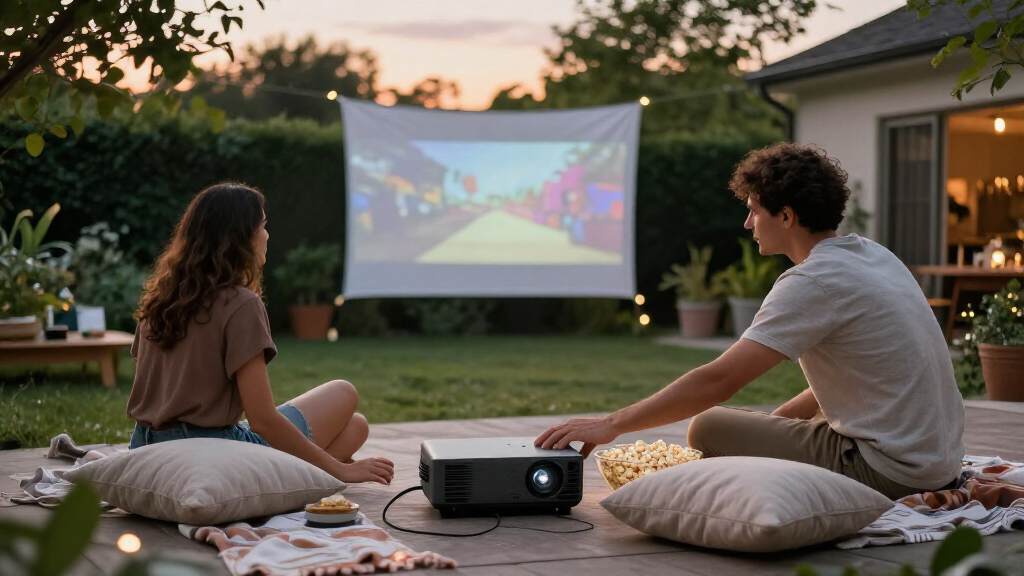
How We Picked
I ranked these movie night projectors by the factors that most affect a shared viewing setup: stated native resolution, access to streaming, connection options, placement flexibility, and included accessories. I gave more weight to features that make it easier to start a film and get a usable image than to headline compatibility claims alone. A projector with native 1080p and a clear streaming path has an advantage over one whose main distinction is 4K support or wireless version numbers.
The order also reflects who each model serves best. The HAPPRUN with Official Google TV leads for its combination of native Full HD and integrated streaming; other Roku and app-equipped picks follow when their convenience, portability, or specialized setup is a better fit. I treated missing information about brightness, audio performance, and setup assistance as a reason to avoid assuming every model will suit a bright room or replace a sound system. Since no product is ideal for every room, each recommendation includes a tradeoff readers should weigh before choosing.
Factors to Consider When Choosing Movie Night Projectors
Before choosing among these models, I’d plan the viewing setup rather than shop by feature count. A projector that suits a dark bedroom may disappoint in a bright living room, and a built-in streaming interface only helps if it supports the services and connections you need.
Match Resolution Claims to Your Viewing Distance
Check whether a listing identifies native resolution or only says it supports a higher-resolution input. Native 1080p describes the image the projector displays; 4K support can simply mean it accepts a 4K source and scales it down. At a typical movie-night distance, a sharp, correctly focused Full HD image can be more useful than an inflated compatibility claim. Also think about how large you plan to project: flaws are easier to notice on a very large image, especially with subtitles and detailed scenes. I’d compare native resolution first, then use screen size and seating distance to decide whether added image detail will matter in your room.
Plan for Room Light and Screen Size
Ambient light changes the viewing experience more than many feature lists suggest. A modest portable projector is generally better suited to a dim room than a bright space where sunlight or ceiling lights wash out dark scenes. Decide where the projector will sit and how large an image the room can support before settling on a model. A bigger picture is not automatically better if it forces you to sit too close or makes the image look less clear. If daytime viewing is a regular need, prioritize verified brightness information and consider whether curtains or a dedicated screen can improve the setup.
Choose Built-In Streaming or an External Source
Built-in Google TV or Roku can make movie night easier by putting streaming apps and navigation in the projector itself. The tradeoff is that an external streaming device may be easier to replace or upgrade, and it can give you a familiar interface across different displays. Before buying, check whether your preferred streaming services are available through the built-in platform and whether the projector has the ports you need for a console, laptop, or streaming stick. Some phones and tablets also restrict video output or app playback, so wireless mirroring may not work like a direct HDMI connection. I’d choose integrated apps for simplicity and a separate source when flexibility matters more.
Treat Audio as Part of the Setup
Built-in speakers are convenient for a quick bedroom viewing, but they may not give dialogue or music the presence you want for a group movie night. Bluetooth can help connect a compatible speaker, though wireless audio can introduce pairing steps or delay. If you already own a soundbar or speaker system, check the projector’s available audio outputs and your source device’s connection options before purchasing. A bundled screen, like the one included with the TMY V08, can save setup work, but it does not solve sound limitations. I’d budget for audio separately if shared listening and clear dialogue matter as much as the picture.
Check Placement, Power, and Setup Features
Placement flexibility affects how often you use the projector. Rotating stands can help aim a unit at a wall or ceiling, while USB-C power can make a portable setup easier to arrange if a suitable power source is available. Auto focus and image correction can reduce setup effort, but they do not remove the need to point the projector toward a suitable surface and keep the image within its supported range. Measure the distance from the intended location to the screen and check how much space the projector needs around it. For travel or shared rooms, give more weight to power options and quick positioning; for a fixed movie room, stable placement may matter more than a rotating mount.
Frequently Asked Questions
Is native 1080p worth choosing over a projector that supports 4K?
Native resolution and input support are different claims. A native 1080p projector displays up to its own Full HD resolution, while a 4K-supported model may accept a 4K signal and scale it down. For most buyers comparing these options, I’d favor a clearly stated native resolution over a higher input-compatibility label. The room, image size, source quality, and focus also affect perceived sharpness. Choose based on what the projector displays, not only what signal it can receive.
Can I use a movie night projector in a living room with the lights on?
Room brightness is a major limitation for compact projectors. Ambient light reduces contrast and can make darker film scenes harder to see, even when the projector accepts a high-resolution source. These models are generally easier to enjoy with lights dimmed or curtains closed. If you plan to watch regularly during the day, compare trustworthy brightness specifications and consider a screen suited to your room. A larger image will not compensate for a washed-out picture.
Should I choose built-in Roku or Google TV instead of buying a streaming stick?
Built-in streaming favors a simpler setup, since you can access supported apps without adding another device. A streaming stick can be a better fit if you want to keep the interface consistent across screens or replace the streaming hardware separately from the projector. Check whether your preferred services work on the projector’s platform and whether app updates are supported. For either approach, a wired connection can be more dependable than phone mirroring for protected video. The right choice depends on whether fewer devices or easier upgrades matter more to you.
Will Bluetooth connect my projector to a soundbar without audio delay?
Bluetooth is convenient, but lip-sync can vary by projector, speaker, and source. Some combinations keep dialogue in sync; others may introduce a noticeable delay during films. Check whether the projector offers audio-sync controls or a wired audio connection if timing matters to you. Pairing can also add a step before each viewing session, so test compatibility if possible. Buyers who already own a soundbar should confirm its supported inputs before relying on wireless audio.
Do I need a separate screen for movie nights?
A separate screen is not always necessary if you have a smooth, matte, light-colored wall and can control the room lighting. A dedicated screen can provide a more consistent surface and may help when the wall has texture, color, or marks. The TMY V08 includes an 80-inch screen, which can make a first setup more straightforward, but buyers should still check that the size suits their room and seating distance. Screen choice cannot fix insufficient brightness or a projector placed at the wrong distance. I’d sort out placement and room light before choosing an accessory.
Conclusion
For most buyers, I’d choose the HAPPRUN Native 1080p Projector with Official Google TV as the best overall: it pairs native Full HD with an integrated streaming route. The best value for a ready-made setup is the TMY V08 if its included 80-inch screen fits your needs; the tradeoff is that the screen bundle does not guarantee the strongest picture or audio for every room. For a more feature-focused pick, the WiMiUS P62 Pro is my premium-style choice among this lineup, thanks to its built-in apps and Wi-Fi 6, though I would not treat 4K support as native 4K resolution. Beginners may prefer an Aurzen Roku TV model for familiar built-in streaming, while travelers and flexible-room users should look at the D1R Air with USB-C power or rotating-stand options. Match your final choice to room light, streaming preferences, and where the projector will sit—not to feature labels alone.