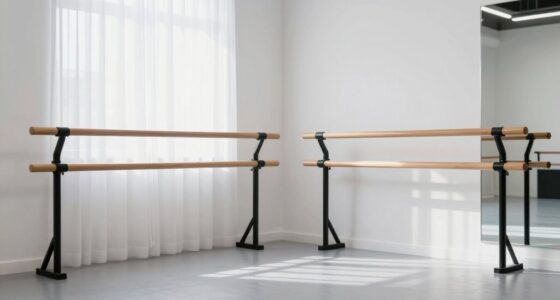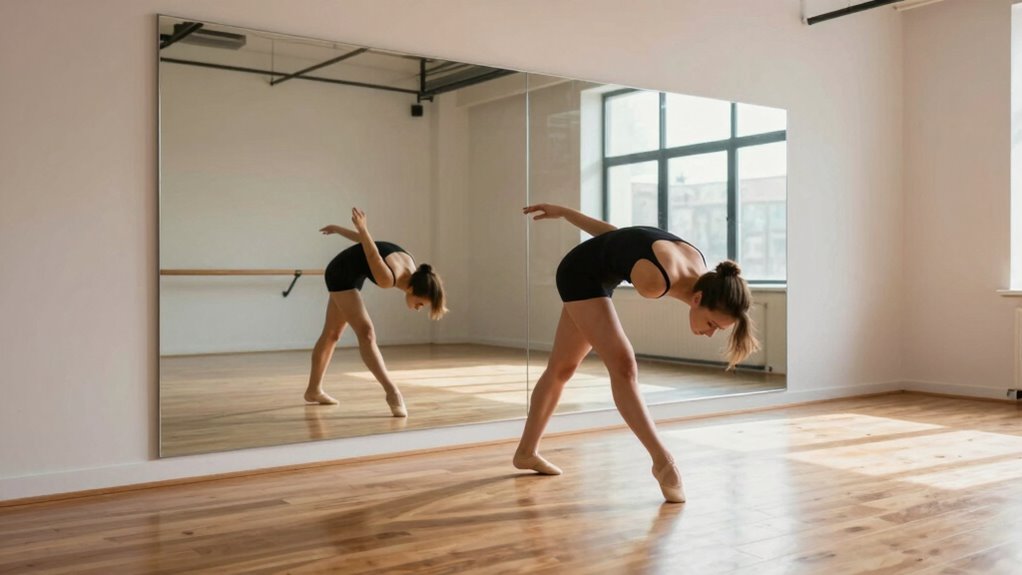

Most dancers place their mirrors at eye level or directly in front, but ideal placement is often more strategic. To get the clearest feedback, position your mirror at an angle that minimizes glare, avoids distortion, and allows full-body visibility without excessive head movement. Adjusting lighting and ensuring a clean, well-placed mirror can dramatically improve your form and awareness. Keep exploring these tips to discover where your best mirror setup truly lies.

Get movie nights delivered free with Prime
- Fast, free delivery on millions of items
- Prime Video, Amazon Music and more included
- Member-only deals all year
Key Takeaways
- Place mirrors at angles that allow full-body visibility without excessive head movement for better posture correction.
- Position mirrors perpendicular to light sources to reduce glare and distortion, enhancing reflection clarity.
- Use larger mirrors strategically placed to capture entire movements, not just frontal views.
- Adjust mirror placement based on lighting conditions and environment to optimize visibility and reduce reflections.
- Avoid standard front or eye-level placement; instead, experiment with angles and heights for personalized, effective feedback.
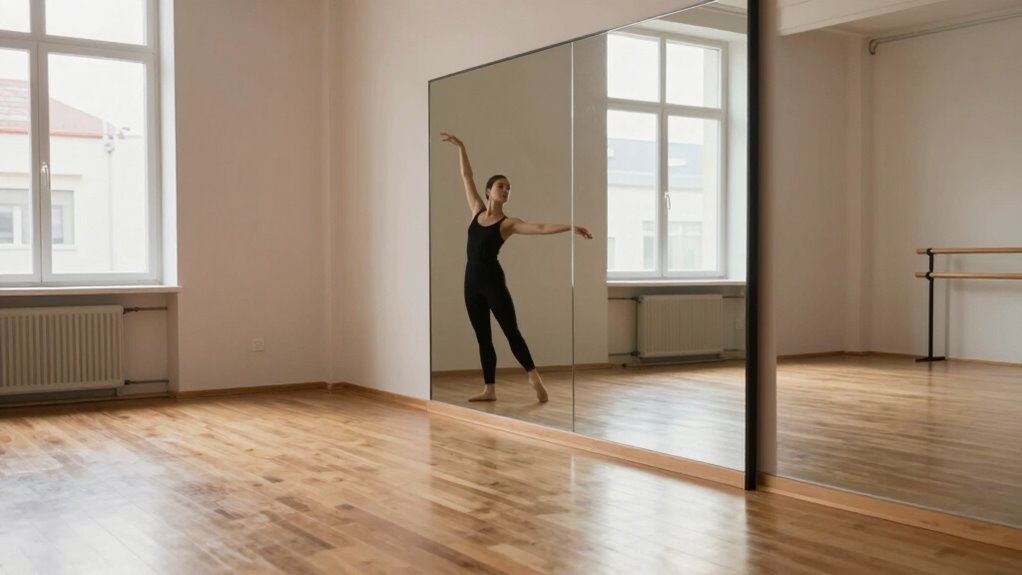
Proper mirror placement is essential for effective dance corrections because it allows you to see your movements clearly and make immediate adjustments. But the typical spot many dancers choose isn’t always the best. Instead of placing the mirror directly in front or at a standard eye level, consider how lighting angles and mirror size influence what you see. The way light hits the mirror can dramatically affect visibility, so positioning it where natural or studio lighting minimizes glare and reflections is key. For example, placing the mirror perpendicular to windows or light sources helps prevent harsh reflections that distort your view. You want to see your form, not a washed-out or overly bright glare that makes it hard to judge details.
When it comes to mirror size, bigger isn’t always better, but it does matter. A large mirror provides a full view of your body, which is especially useful for checking alignment and posture. However, if it’s too large or placed poorly, parts of your movement might get lost or distorted at the edges. You should position the mirror so that you can see your entire body without having to shift your head excessively or move too close. This often means placing a sizable mirror at an angle that captures your full figure from head to toe while still allowing you to focus on specific areas when needed. Additionally, considering the lighting conditions can significantly improve your ability to see your reflection clearly, which is why understanding how light interacts with your mirror setup is so important. Adjusting your mirror placement to account for these factors can make a noticeable difference in your practice effectiveness. Incorporating visual feedback through proper placement can help you develop better awareness of your movements over time. Moreover, being aware of the softener brine impact in water systems can enhance the overall environment, reducing glare and reflections caused by water spots or mineral buildup on the mirror surface.
Popular right now

Bose QuietComfort Headphones (2nd Gen), Wireless Noise-Cancelling Over-Ear Headphones, Eucalyptus Green

De'Longhi Magnifica Duo Fully Automatic Espresso Machine with Milk Frother, Silver

KitchenAid Commercial Series 8-Quart Bowl-Lift Stand Mixer, White
As an affiliate, we earn on qualifying purchases.
Frequently Asked Questions
How High Should a Dance Mirror Be Installed for Optimal Correction?
You should install your dance mirror so that its height allows you to see your entire body clearly, typically around eye level or slightly above, depending on your height. The ideal placement guarantees you can observe your movements without craning your neck or bending down. Adjust the mirror height so that it provides a full view of your dance posture and technique, helping you make precise corrections effortlessly.
Can Multiple Mirrors Improve Dance Correction Effectiveness?
Imagine a web of mirrors surrounding you, each capturing different angles of your dance. Multiple mirrors can enhance correction by offering diverse reflection clarity and ideal mirror angles. This setup allows you to see your movements from multiple perspectives, catching subtle errors you might miss in a single mirror. With better visual feedback, you’ll refine your technique faster and more accurately, elevating your dance performance to new heights.
What Are Common Mistakes When Placing Dance Mirrors?
You often make mistakes with mirror placement by ignoring proper mirror orientation and wall placement. Placing mirrors directly facing dance areas can cause glare and distortions, while poor wall placement limits visibility of your movements. To correct this, make certain mirrors are angled properly and positioned on walls that reflect your entire body. Avoid obstructions and maintain a clear line of sight, so you can accurately assess your form and improve your dance skills.
How Do Lighting Conditions Affect Mirror Visibility During Practice?
Lighting can make or break your mirror visibility. I once struggled during evening practice because glare from harsh lights created visibility shadows, making it hard to see corrections clearly. Bright, uneven lighting causes glare and shadows that distort your reflection, so you can’t trust what you see. Opt for soft, evenly distributed light to reduce glare and shadows, ensuring your mirror provides a true, consistent view of your dance form.
Is It Better to Have a Single Large Mirror or Multiple Smaller Ones?
A single large mirror is better because it offers a complete view, making it easier for you to see your entire form and movements. Focus on a strategic placement strategy that minimizes blind spots and reduces distortion. Multiple smaller mirrors can work, but they often create fragmented views that hinder overall correction. Prioritize size and placement to guarantee you get a clear, consistent reflection that helps improve your dance technique effectively.
Conclusion
So, next time you set up your dance studio, think beyond the usual spot. Place your mirror where you can see your full reflection without turning your head like a medieval scribe copying scrolls. This simple shift might just be the secret to perfecting your form. Trust me, with a little tweak, you’ll dance more confidently—almost like you’ve stepped into a Renaissance painting, poised and graceful, ready to impress.