TL;DR

Get movie nights delivered free with Prime
- Fast, free delivery on millions of items
- Prime Video, Amazon Music and more included
- Member-only deals all year
Nick Park made about 90% of A Grand Day Out himself while developing the Wallace and Gromit characters as a student film project. The short premiered at the Bristol Animation Festival in November 1989, later won a BAFTA and helped launch a series that became central to Aardman’s identity. The account comes from Animation Obsessive’s retrospective; it does not report a new film or announcement.
Nick Park made about 90% of A Grand Day Out himself, according to a retrospective published by Animation Obsessive, describing the largely solo production that introduced Wallace and Gromit and began Park’s defining association with the characters. The short premiered at the Bristol Animation Festival in November 1989; it later won a BAFTA, although another Park film, Creature Comforts, was selected for the Academy Award.
The report traces A Grand Day Out to 1982, when Park was a student at Britain’s National Film and Television School. He needed characters for his graduation film and returned to an old sketchbook. The initial idea was a journey to the moon in a rocket built in a basement. Wallace’s fondness for cheese came later as a reason for the trip. Gromit began as a cat, while Wallace was originally drawn with a mustache.
Park did receive assistance, but the report says the film’s limited budget left him responsible for most of its production. He worked on the script with Steve Rushton, a friend and aspiring children’s-book writer. Animators Alison Snowden and David Fine made some props, a school technician built the rocket console, and actors Peter Sallis and Peter Hawkins provided voices. Park obtained Plasticine from its manufacturer without charge.
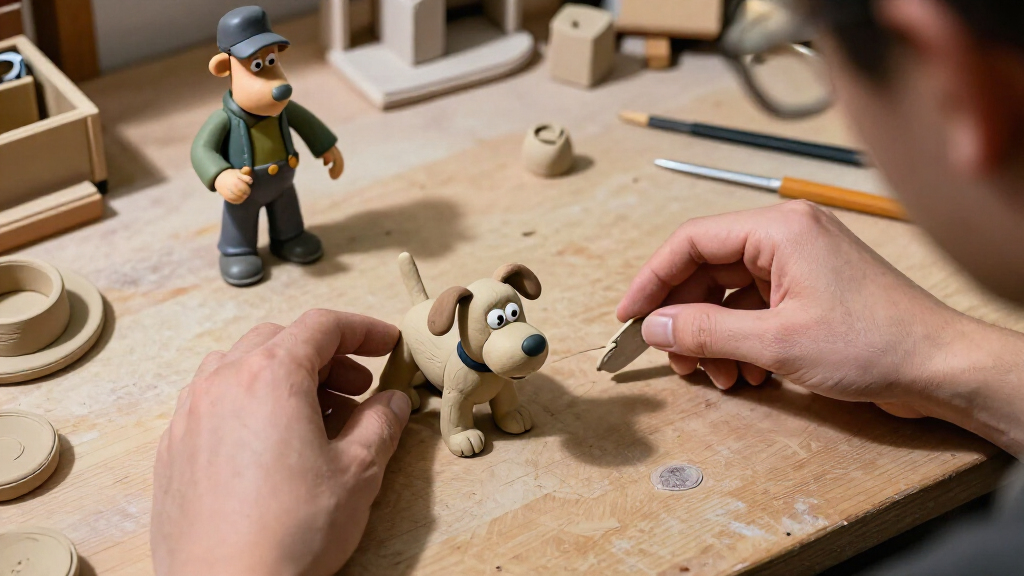
Some of the film’s best-known character traits grew out of practical problems. Park changed Gromit into a dog because he found dogs easier to model. He removed the character’s dialogue early in production after finding animation difficult, then built Gromit’s expressiveness around his eyes. Wallace’s wide mouth also developed as Park animated Sallis’s delivery of the word “cheese.” The report presents these decisions as part of the film’s gradual development, rather than as elements of a fully planned production.
The Short That Shaped Aardman
The production account helps explain why A Grand Day Out mattered beyond its awards. Park’s constraints pushed him to find visual ways to communicate personality, particularly through Gromit’s eyes and Wallace’s exaggerated mouth. Those choices became part of the recognizable style of Wallace and Gromit, according to Park’s recollections cited by Animation Obsessive.
The film also marked a turning point for Park and Aardman. Before the Bristol screenings, Park was not widely known. The report says the work drew the attention of studio co-founders Peter Lord and David Sproxton, as well as artists Park admired, including Terry Gilliam and Ray Harryhausen. After the film aired on Channel 4 in 1990, it reached a broader audience. Its eventual BAFTA win helped give the early short recognition, even though Creature Comforts won the Academy’s award.
For readers, the story is a reminder that the celebrated character pair was not created through a large, established production operation. The film was a student project assembled over years, with limited help and a substantial amount of hands-on work by its director. That history offers a specific account of how technical limits and iterative choices shaped a landmark of British stop-motion animation.
Plasticine modeling clay for animation
As an affiliate, we earn on qualifying purchases.
As an affiliate, we earn on qualifying purchases.
From Student Film to Premiere
Park began work on the film in 1982 and continued through much of the decade. Animation Obsessive describes it as an ambitious graduation project that took longer than he expected and that Park considered abandoning more than once. The account says he had been making animation since childhood, including 8 mm films, and had developed his craft through practice before and during his film-school years.
In November 1989, Park screened A Grand Day Out alongside Creature Comforts at the Bristol Animation Festival. The retrospective says both screenings went well, but neither immediately produced extensive media attention. One magazine described the short as a “marvelous Lancastrian model animation” about a cheese-loving man and his dog traveling to the moon. The films were later shown on Channel 4 in 1990, giving Park’s work a wider audience.
The two shorts had different award outcomes. Creature Comforts was the Academy’s choice, while A Grand Day Out received a BAFTA. Animation Obsessive characterizes the short’s success as quieter, but says it began a much larger story for Wallace and Gromit. The account situates that success within Aardman’s wider history: Park joined the studio after work on the film, and his visual approach later became closely associated with its output.
“I did probably 90% of it myself.”
— Nick Park, as quoted in the Animation Obsessive retrospective
As an affiliate, we earn on qualifying purchases.
What the Retrospective Establishes
The source is a retrospective, not a new production announcement or a report of a current development involving Wallace and Gromit. It recounts earlier events using quotations and historical material, but the supplied excerpt does not give a complete production ledger or independently document precisely how Park’s estimate of about 90% was calculated. The figure should be understood as Park’s own approximate description, not an audited division of every task.
The report also does not provide a full account of the film’s budget, the exact dates of every production stage, or the complete circumstances behind its awards. It says Creature Comforts was the Academy’s pick and A Grand Day Out received a BAFTA, but does not name the award years or offer further detail on the voting. No new project, release date or future production is announced in the material.
animation character design software
As an affiliate, we earn on qualifying purchases.
As an affiliate, we earn on qualifying purchases.
No New Release Announced
Animation Obsessive’s piece looks back at the making and reception of A Grand Day Out; it does not identify a next production milestone. The immediate takeaway is historical: Park’s student film was screened in Bristol in 1989, reached television audiences in 1990 and established characters whose style became closely tied to his work.
Any current developments involving Wallace and Gromit would need to be confirmed through a separate, up-to-date announcement from Aardman or another attributable source. The retrospective itself offers no release schedule or indication that the production history described here is linked to a forthcoming film.
As an affiliate, we earn on qualifying purchases.
Key Questions
What does “90% alone” refer to?
It refers to Nick Park’s estimate that he made probably 90% of A Grand Day Out himself. He still received specific assistance with the script, props, the rocket console and voice performances.
When did A Grand Day Out premiere?
The short screened at the Bristol Animation Festival in November 1989, alongside Park’s film Creature Comforts.
How did Gromit become a silent dog?
Park said he changed Gromit from a cat into a dog because dogs were easier for him to model. He cut Gromit’s dialogue during the first week of shooting after finding it difficult to animate, and developed the character’s expression through his eyes.
Did A Grand Day Out win an Oscar?
No Oscar win is reported. According to Animation Obsessive, Creature Comforts was the Academy’s pick, while A Grand Day Out received a BAFTA.
Does this report announce a new Wallace and Gromit film?
No. The source is a retrospective about the making and early reception of A Grand Day Out; it gives no new film announcement or release date.
Source: hn
Halloween Picks
halloween
As an affiliate, we earn on qualifying purchases.