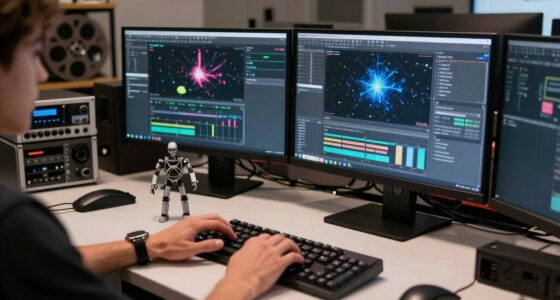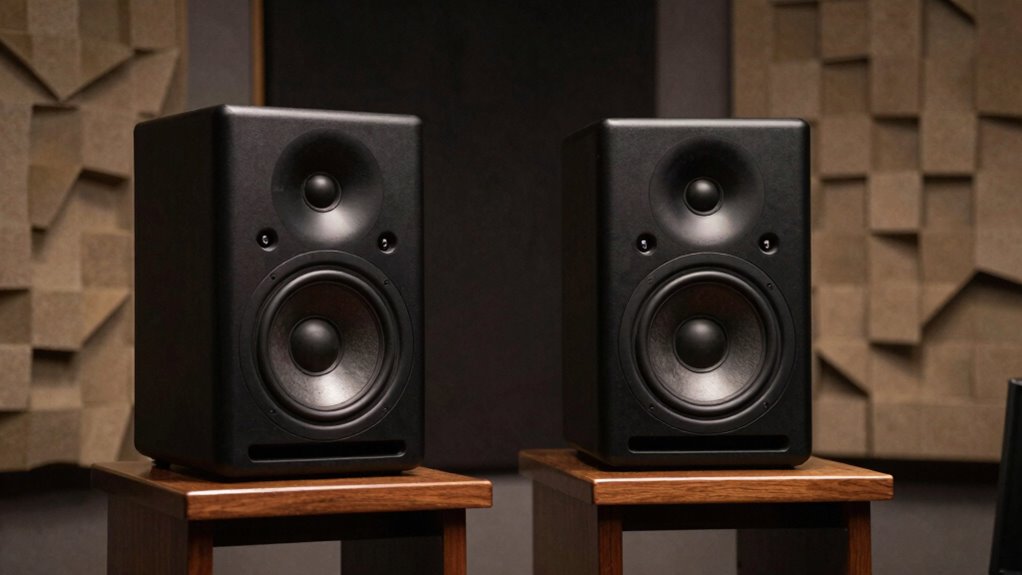

To guarantee your studio monitors sound right, you need to place them correctly and consider your room’s acoustics. Proper positioning involves keeping monitors at ear level, forming an equilateral triangle with your listening position, and avoiding walls or corners that cause reflections. Room treatments like bass traps and diffusers help reduce unwanted echoes. When you get these setup details right, your sound becomes clearer and more accurate. Your listening experience will improve—keep exploring to learn how to perfect your setup even further.

Get movie nights delivered free with Prime
- Fast, free delivery on millions of items
- Prime Video, Amazon Music and more included
- Member-only deals all year
Key Takeaways
- Proper monitor placement ensures accurate sound reproduction and minimizes phase issues.
- Correct positioning reduces reflections and standing waves, improving sound clarity.
- Room acoustics and measurements help identify optimal monitor placement for balanced sound.
- Using isolation pads prevents vibrations from coloring the monitor’s sound.
- Strategic placement enhances translation of mixes to other listening environments.
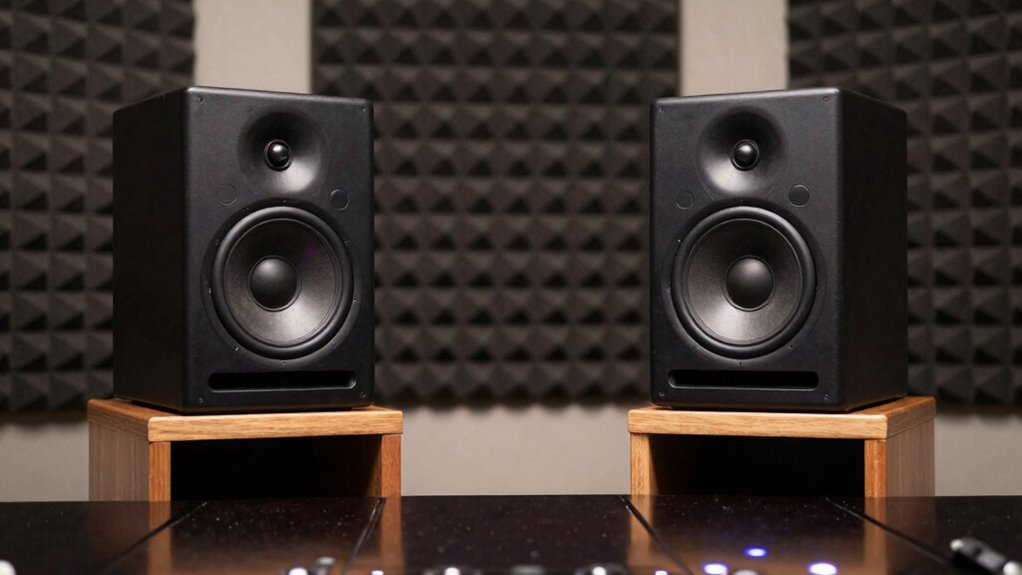
Have you ever wondered why your studio mixes sound off even though your monitors are high quality? The answer often boils down to proper placement. Where you position your studio monitors can make or break your listening experience, and understanding the role of room acoustics and speaker isolation is essential. When your monitors aren’t placed correctly, even the best speakers can produce inaccurate sound, leading to mixes that don’t translate well.
Room acoustics play a significant role in how your monitors sound. Every room has its own reflective surfaces, corners, and dimensions that influence sound waves. If your room has hard, reflective surfaces like glass or bare walls, sound bounces around, creating echoes and standing waves. These distort the true sound your monitors are producing, making it difficult to judge frequencies accurately. To improve this, you need to address your room’s acoustics—adding bass traps, diffusers, and absorbers can help tame reflections and create a more neutral listening environment. When your room is acoustically treated, your monitors can work more effectively, delivering a clearer and more accurate sound. Understanding sound wave behavior can help you further optimize your setup and reduce unwanted reflections. Additionally, incorporating proper room measurements can assist in identifying specific acoustic issues that need correction.
Addressing room reflections with bass traps and absorbers creates a clearer, more accurate listening environment for better mixes.
Speaker isolation is another critical factor. Even if your monitors are perfectly positioned, vibrations from the speakers can transfer into your desk or stand, muddying the sound. This is why isolating your monitors with pads or stands is crucial. Proper speaker isolation prevents unwanted vibrations from coloring your sound, helping you hear details that might otherwise be masked. Without isolation, the sound can seem boomy or inconsistent, which hampers your ability to make precise adjustments during mixing. Ensuring proper monitor placement is essential for achieving an accurate listening environment.
As an affiliate, we earn on qualifying purchases.
Frequently Asked Questions
How Do Room Acoustics Affect Studio Monitor Placement?
Room acoustics greatly influence your studio monitor placement because poor acoustics cause sound reflections and distortions. By applying soundproofing techniques and acoustic treatment options, you can minimize unwanted echoes and improve sound clarity. Proper placement, combined with these treatments, guarantees your monitors produce accurate, balanced sound. So, consider your room’s acoustics carefully and optimize placement for the best listening experience.
What Is the Ideal Distance Between Monitors and Walls?
Did you know that placing monitors 2-3 feet away from walls can improve sound clarity? For ideal sound, keep your monitors about 1 to 2 feet from walls, allowing space for proper Subwoofer integration and reducing unwanted reflections. Use soundproofing techniques like foam panels to minimize wall effects. Proper distance guarantees balanced sound, allowing your monitors to deliver accurate mixes without wall-induced distortions.
Can Placement Impact Frequency Response Accuracy?
Placement definitely impacts frequency response accuracy. Proper speaker positioning guarantees ideal frequency calibration, reducing issues like bass booms or shrill highs. When you position your monitors correctly, you create a more balanced soundstage, making it easier to hear true audio details. Adjusting your monitors to the right spot helps you achieve a flat, accurate frequency response, so your mixes translate well across various listening environments.
How Do I Prevent Sound Reflections From Nearby Objects?
To prevent sound reflections from nearby objects, you should apply soundproofing techniques like placing bass traps and diffusers, which absorb and scatter sound waves. Use acoustic treatment such as foam panels or curtains to minimize reflections off walls and furniture. Keep objects away from your monitors and position them away from reflective surfaces. These steps help create a controlled environment, ensuring your studio monitors deliver accurate, clear sound without unwanted echoes or reflections.
Does Monitor Height Influence Sound Clarity?
Yes, monitor height greatly influences sound clarity. When your monitors are at ear level, you guarantee the sound reaches you directly without distortion or muffling. Adjusting the height helps align the tweeters with your ears, providing a more accurate stereo image and better frequency response. Proper monitor height reduces listening fatigue and improves your ability to hear subtle details, making your mixes clearer and more precise.
room acoustic treatment bass traps
As an affiliate, we earn on qualifying purchases.
As an affiliate, we earn on qualifying purchases.
Conclusion
Remember, proper placement is the key to capturing clear, accurate sound. When you position your studio monitors precisely, you prevent poor performance and produce perfect pitches. Take your time, tweak your setup, and trust your ears. By balancing, backing, and binging on the basics, you’ll boost your sound, boost your skills, and bring brilliance to your beats. Perfect placement paves the path for pristine, professional sound — so place them thoughtfully and listen closely!
As an affiliate, we earn on qualifying purchases.
studio monitor positioning tools
As an affiliate, we earn on qualifying purchases.
As an affiliate, we earn on qualifying purchases.
Fall Picks
fall essentials
As an affiliate, we earn on qualifying purchases.