
TL;DR

Get movie nights delivered free with Prime
- Fast, free delivery on millions of items
- Prime Video, Amazon Music and more included
- Member-only deals all year
A producer for NPR’s Wild Card found gibberish comments on Spotify and suspected bots, but NPR’s Hannah Chinn concluded they were middle schoolers using the quiet comment section as a group chat. The story was reported on This American Life. It shows how kids repurpose overlooked digital spaces when mainstream apps are blocked.
A producer at the public radio show Wild Card discovered what looked like a bot invasion in his podcast’s Spotify comments last fall — but the apparent bots turned out to be middle schoolers using the comment section as a secret group chat, according to an account broadcast on This American Life. The episode, titled around the discovery, details how a generational gap inside NPR nearly led the kids’ hangout to be reported to Spotify as spam before a younger staffer recognized the behavior for what it was.
Dave Blanchard, who runs Wild Card with Rachel Martin on NPR, monitors online comments about the show as part of his job. Last fall, he noticed a burst of activity on the Spotify page for the show’s episode with writer Elizabeth Gilbert. At first he assumed the surge meant the controversial episode had struck a nerve. Instead, the comments were, in his words, “just these clipped, weird, incoherent postings.”
Blanchard initially suspected bots. But the comments came from many different accounts and appeared to interact with one another, which did not match typical bot behavior. The messages themselves read like fragments of casual conversation: “Ah, OK, M-H.” “Gilgamesh quit and I’m crying.” “Last Friday I broke up with my GF.” “Your cats are so cute.” “You’re gorgeous in that dress. OML, pink heart.”
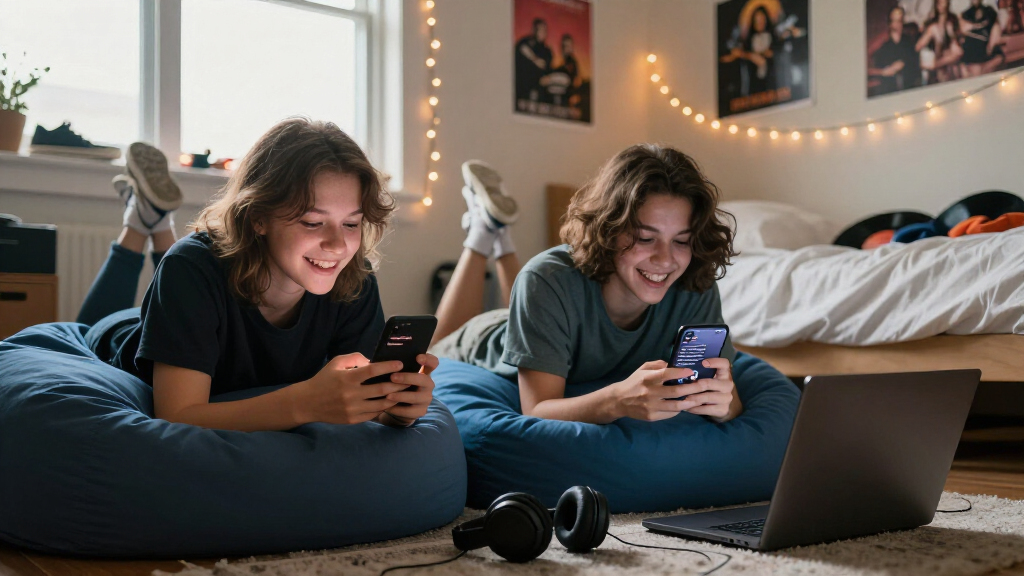
The picture became clearer after Blanchard deleted the comments. A new comment appeared saying “so it deleted my com,” followed by reactions like “Weird” and “That’s weirdss.” Blanchard shared screenshots in NPR’s Slack channels, and a supervisor suggested reporting the activity to Spotify. That is when Hannah Chinn, an NPR staffer roughly ten years younger than Blanchard, looked at the screenshots and reached a different conclusion. Chinn said the display names — “Ella with five emojis,” using special characters generated online — the cartoon profile pictures, and the rapid short exchanges all pointed to middle schoolers, not bots. Chinn guessed the kids were using Spotify comment threads “as their group chat, maybe because other apps on their phone are blocked,” and had simply landed on a Wild Card episode to do it.
Why a Comment-Section Chat Matters
The story resonates because it captures two trends at once. First, it illustrates how parental controls and school device restrictions push young users toward unexpected corners of the internet: when conventional messaging apps are blocked, any platform with a text field becomes a potential chat room. Chinn drew on personal experience, describing how they once communicated with friends through Google Docs, typing messages and deleting them or making text invisible by turning it white.
Second, it shows how generational interpretation gaps shape moderation decisions. Blanchard, a millennial, saw gibberish and bots; Chinn, from Gen Z, recognized the social grammar of young teens — lots of greetings, exclamation points, and mutual acknowledgment rather than substantive conversation. Had the report gone to Spotify, the kids’ hangout could have been flagged and removed as spam without anyone understanding what it was.
How the Misread Unfolded at NPR
According to the This American Life transcript, Blanchard remained skeptical after Chinn’s Slack message, replying “That’s an interesting theory” — with, as he acknowledged, an exclamation point added to soften it. He found it implausible that middle schoolers would land on Wild Card, a show not aimed at them, as their meeting place.
Chinn, meanwhile, was confident enough to push back internally. Chinn had grown up homeschooled in a conservative household with limited social media access, and described recognizing the behavior as familiar from their own childhood online. Chinn then continued investigating, and the account suggests the kids’ method became clearer: one participant would create a Spotify playlist with a name such as “Let’s chat here”, turning the playlist and the comment thread into a rendezvous point for the group.
“It screamed bots, just because anytime that I see just gibberish in a comment on the internet, I assume it’s a bot. But the fact that they were all from different accounts seemed very weird.”
— Dave Blanchard, Wild Card producer
What the Story Still Doesn’t Answer
Key details about the kids themselves remain unknown. The account does not identify them, their location, or how they first found the Wild Card episode’s comment section. Chinn’s explanation — that they may have used Spotify because other apps were blocked on their phones — was explicitly framed as a guess (“Who knows?”), not a confirmed motive.
The available transcript is also truncated mid-detail, cutting off as Chinn describes how one kid would create a playlist named “Let’s chat he[re]” — so the full scope of what the reporting established is not visible in the source material. Whether the comment activity continued after Blanchard’s deletions, and whether it was ever reported to Spotify, is not stated in the portion available.
The Story’s Life After Broadcast
No moderation action or policy change by NPR or Spotify has been announced in connection with the incident. The story’s main afterlife is likely cultural: it has circulated as an example of how young users adapt whatever tools are available to socialize, and as a case study in how moderation teams of different ages can read the same content very differently. Readers interested in the complete account, including the full resolution, can consult This American Life episode 897, where the segment appears in the prologue.
Key Questions
What exactly were the kids doing on the NPR podcast’s Spotify page?
According to the This American Life account, middle schoolers were posting short, casual messages back and forth in the comment section of a Wild Card episode on Spotify — effectively using it as a group chat. They also appeared to create playlists with names like “Let’s chat here” as meeting points.
Why did NPR staff initially think the comments were bots?
Producer Dave Blanchard said the comments looked like “clipped, weird, incoherent postings” — gibberish that he associated with bots. The tipping point away from that theory was a comment noticing that a thread had been deleted, behavior that seemed too aware for a bot.
How did Hannah Chinn figure out the comments came from kids?
Chinn cited telltale signs: display names decorated with special-character emojis, cartoon profile pictures, and the conversational style — lots of greetings, exclamation points, and short acknowledgments. Chinn said the pattern matched their own experience of being a middle schooler posting on internet forums.
Is it confirmed the kids were using Spotify because other apps were blocked?
No. Chinn offered that as a guess — “maybe because other apps on their phone are blocked. Who knows?” — in a Slack message to NPR colleagues. The motive remains speculation and was not confirmed in the reported account.
Where can I hear or read the full story?
The segment appears in the prologue of This American Life episode 897, with a transcript published on the show’s website at thisamericanlife.org.
Source: hn
Fall Picks
fall essentials
As an affiliate, we earn on qualifying purchases.