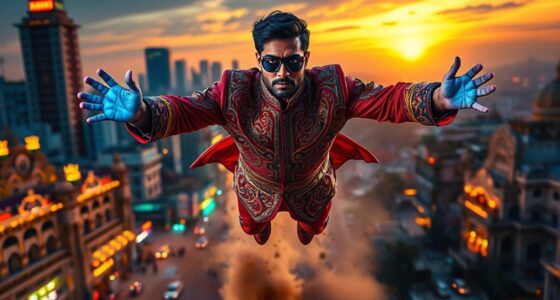
You’ll notice that today’s high-octane action scenes blend real stunts with CGI, creating spectacular visuals that push limits without risking lives. Back in the day, filmmakers relied on practical effects like real explosions and daring stunt performers, which felt more authentic but were riskier. Now, digital enhancements allow for impossible sequences while still maintaining the energy of practical effects. If you keep exploring, you’ll discover how these techniques have evolved and revolutionized modern filmmaking.
Key Takeaways
- Early action scenes relied on real stunts and practical effects, providing visceral authenticity and physical risk.
- Modern sequences blend real stunts with CGI, enhancing spectacle while maintaining realism.
- Practical effects offered immediate, tangible thrills, whereas CGI enables impossible or safer stunts.
- The integration of CGI has expanded creative possibilities, producing visually spectacular and physics-defying sequences.
- Despite technological advances, the core appeal of high-octane action still depends on daring stunts and authentic physical interactions.
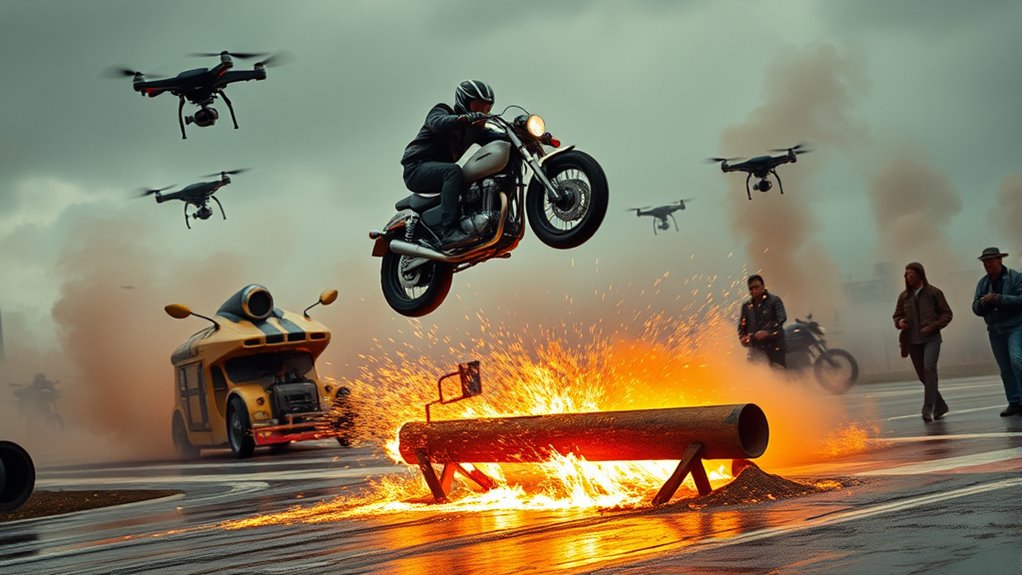
Over the years, stunt work and action sequences have evolved dramatically, transforming from practical, on-set feats to high-tech, computer-generated spectacles. In the early days of filmmaking, you’d watch a stunt performer execute dangerous moves directly in front of the camera, relying on skill, timing, and ingenuity. Practical effects were the backbone of these sequences, creating real explosions, car crashes, and fall sequences that grounded the action in reality. These effects demanded precision and bravery, as actors and stunt performers put themselves at risk to deliver authentic thrills. The rawness of practical effects gave scenes a visceral energy that audiences could feel, making every stunt feel immediate and impactful. Additionally, the integration of sound design enhances the intensity and immersion of action scenes, making them more compelling.
Practical effects provided authentic thrills and visceral energy to early action scenes, relying on skill and bravery.
As technology advanced, filmmakers began integrating CGI (computer-generated imagery) with traditional stunt work, marking a pivotal shift. You now see action sequences that blend real stunts with digital enhancements, allowing for more ambitious and visually stunning scenes. CGI integration means that dangerous stunts, which once would have been too risky or impossible to perform safely, can now be simulated flawlessly. For instance, you might watch a chase scene where cars leap over cliffs, with the actual stunt performed by professionals and the more hazardous elements added digitally. This combination offers a safer environment for performers while expanding the creative possibilities for directors.
The shift from purely practical effects to CGI-enhanced sequences doesn’t mean practical effects are obsolete; far from it. Instead, they serve as the foundation, providing authentic textures and physical interactions that CGI can’t replicate on its own. When you observe a fight scene or a building explosion, the best productions often use a mix—practical effects for the tangible elements and CGI to enhance or extend the spectacle. This synergy results in seamless sequences that feel both real and spectacular, elevating the overall viewing experience.
Furthermore, CGI integration has enabled filmmakers to craft sequences that would have been unthinkable in the past. You can now witness entire worlds and impossible stunts that defy physics, all while maintaining the credibility and excitement of practical effects. However, many of the most memorable action scenes still rely heavily on real stunts, supported by digital magic. This balance between practical effects and CGI demonstrates how modern filmmaking has evolved, combining the tangible with the digital to produce high-octane, visually captivating action that keeps you on the edge of your seat.

INSIGNIA 75-inch Class QF Series LED 4K UHD QLED Smart Fire TV with Alexa Voice Remote (NS75-UQFL26)
4K UltraHD Resolution: Experience incredible detail with 4X resolution of 1080p Full HD TVs.
As an affiliate, we earn on qualifying purchases.
Frequently Asked Questions
How Have CGI Effects Changed Stunt Choreography Over the Years?
You’ll notice CGI effects have transformed stunt choreography by blending digital enhancements with practical effects. Today, you can see safer, more complex stunts, as digital effects fill in dangerous moments, reducing risks. This allows stunt performers to execute daring moves that were once impossible or too hazardous. Overall, CGI makes action sequences more spectacular while keeping performers safe, giving filmmakers creative freedom to craft jaw-dropping scenes.
What Safety Measures Are Now Standard During High-Risk Stunts?
Ever wonder how stunt safety has evolved? You now use safety harnesses and fire-resistant gear as standard precautions during high-risk stunts. These measures protect you from injury and ensure the scene runs smoothly. Professional stunt performers also undergo rigorous training and rehearsals to minimize risks. Do you realize how much technology and safety protocols have advanced to keep performers safe while pulling off daring feats?
How Do Stunt Performers Train for Complex Action Scenes?
You train for complex action scenes by practicing wire training to master height and movement control, ensuring smooth, safe performances. You work closely with stunt coordinators who design and choreograph sequences, helping you understand timing and safety protocols. Repetition and drills build confidence, while safety measures like harnesses and pads are integrated into training to prepare you for real stunts. This all-encompassing approach boosts your skills and safety during high-risk scenes.
What Role Does Technology Play in Modern Action Sequences?
Imagine technology as your trusty sidekick, transforming raw ideas into breathtaking reality. It enhances practical effects and amplifies stunt coordination, making scenes safer and more spectacular. With CGI and digital enhancements, you can craft impossible stunts, pushing boundaries while minimizing risk. Technology acts as a creative bridge, turning visionary fights and daring jumps into seamless, jaw-dropping sequences that captivate audiences and elevate the art of action filmmaking.
How Have Audience Preferences Influenced Stunt Design and Execution?
You influence stunt design and execution through your evolving expectations. As audiences demand more realism, stunt creators push for innovation, blending practical effects with clever choreography. Your desire for authenticity encourages filmmakers to craft daring, believable sequences, inspiring stunt teams to develop new techniques. This feedback loop drives continuous stunt innovation, making action sequences more exciting and immersive, ensuring they meet your thrill-seeking preferences and keep you engaged from start to finish.

Hisense 75" QD7 Mini-LED 4K Smart Fire TV - QLED, 144Hz, HDR10+, Dolby Vision/Atmos, Game Mode Pro, Alexa Built-in (75QD7QF)
MINILED | UP TO 600 NITS PEAK BRIGHTNESS: See more contrast on the field and off. Lots of...
As an affiliate, we earn on qualifying purchases.
Conclusion
Today’s action sequences are more daring and visually stunning than ever before, thanks to advances in technology. Did you know that the average number of stunt performers per blockbuster has doubled over the past decade? This shows how filmmakers push boundaries to deliver jaw-dropping scenes. As you watch these high-octane moments, remember the incredible effort and innovation behind every stunt, making each sequence more exhilarating than the last. The evolution truly keeps you on the edge of your seat.

LG 75-Inch Class QNED AI 4K QNED82A Series Smart TV w/AI Sound, HDR10, 4K Super Upscaling, Filmmaker Mode, Wow Orchestra, Alexa Built-in (75QNED82AUA, 2025)
DYNAMIC QNED COLOR: LG's Dynamic QNED Color with 100% Color Volume¹ and next-gen AI provides vivid color on...
As an affiliate, we earn on qualifying purchases.

TCL 75-Inch Class S5 UHD 4K LED Smart TV with Fire TV (75S551F, 2024 Model), Dolby Vision and Atmos, HDR PRO+, Alexa Built-in with Voice Remote, Apple AirPlay 2 Compatibility, Streaming Television
4K UltraHD Resolution - Experience incredible detail with 4X the resolution of 1080p Full HDTVs.
As an affiliate, we earn on qualifying purchases.